In the sixty years of united Andhra Pradesh, no government had placed the farmer at the centre of governance. The land revenue systems exploited them, the water went elsewhere, and when crops failed, no one came. Between 2014 and 2023, the Telangana government reversed this completely. Rythu Bandhu transferred Rs.72,815 crore directly into farmers' accounts. The crop loan waiver erased the debts of 58 lakh families. And farmer suicides, 1,500 in 2014, fell to just 56 by 2023, a 95.84% reduction, according to National Crime Records Bureau data. The numbers mark a decade unlike anything in the history of Telugu agriculture.
Chapter VIThe Land TransformedRecord TL·VI·02
When KCR spoke of the farmer, he did not speak in abstractions. He had watched Telangana's farmers die. The suicide counts from Warangal and Nalgonda and Mahbubnagar were not statistics to him but indictments of a system that had never cared. The first act of the new government was the crop loan waiver. The second was to design, from scratch, the most comprehensive farmer welfare architecture that any Indian state had built. Rythu Bandhu, Rythu Bima, Rythu Vedika, AEOs, the abolition of water tax, the Dharani land records portal, and guaranteed procurement at minimum support price, together these constituted a transformation of the relationship between the state and the farmer.
1,500 → 56
Farmer suicides, 2014 to 2023, source: National Crime Records Bureau
In 2014, 1,500 farmers died by suicide in Telangana. In 2015, the number was 1,347, and Telangana accounted for 11.1% of all farmer suicides in India. By 2023, the number had fallen to 56, and Telangana's share of national farmer suicides had dropped to 0.51%. A reduction of 95.84% in eight years. Behind every one of those saved lives was Rythu Bandhu, Rythu Bima, the crop loan waiver, and a government that for the first time in six decades stood unconditionally behind its farmers.
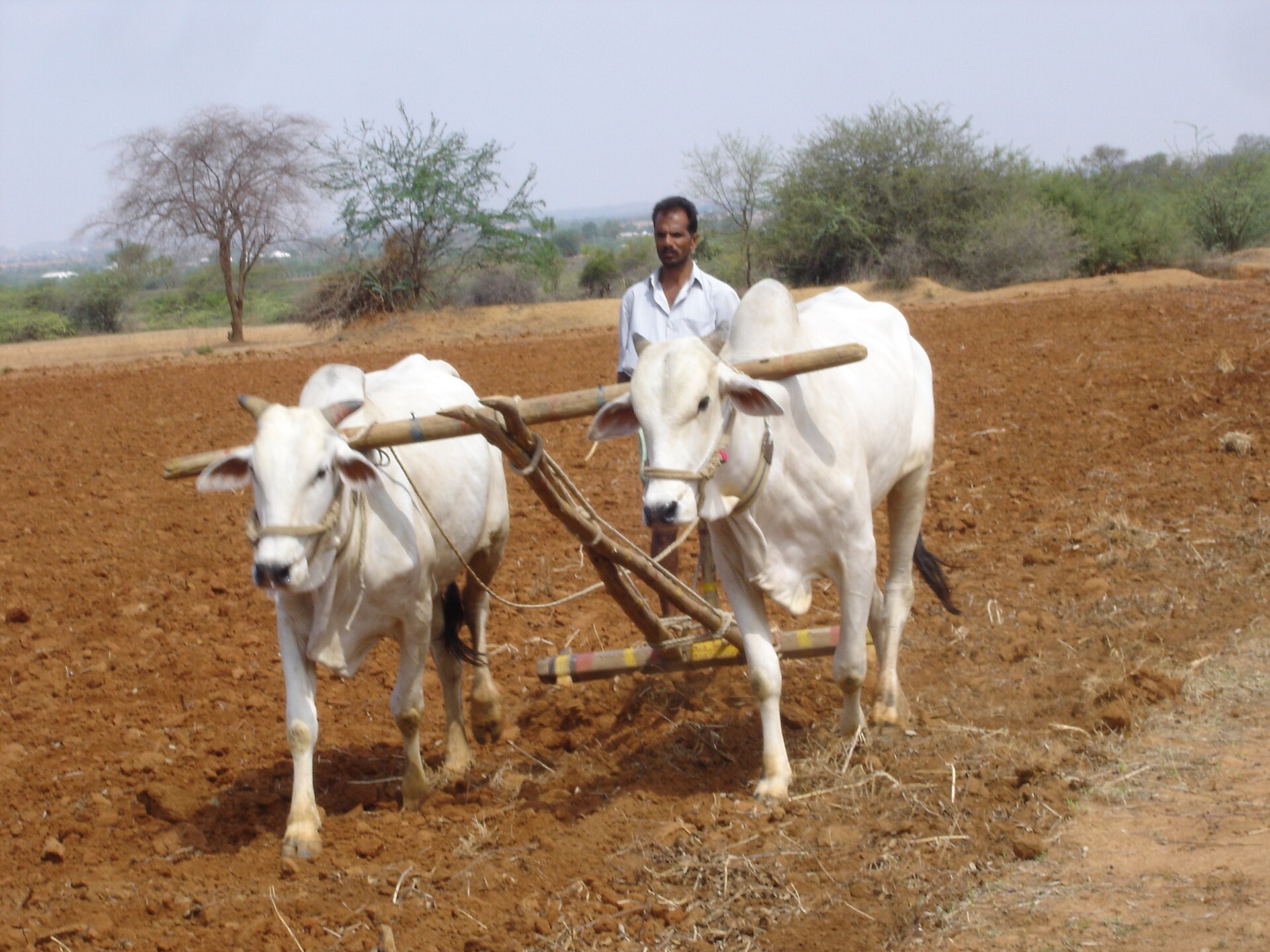
A farmer in Mahabubnagar. Rythu Bandhu put investment directly in his hands: Rs.10,000 per acre per year, before every sowing season, without a single middleman.
Photo: Saibhaskar · Public domain · Wikimedia Commons
Rythu Bandhu: Investment in the Hands of the Farmer
Rythu Bandhu, Crop Investment Assistance Scheme
Rs.10,000 Per Acre Per Year, Directly to the Farmer
Rythu Bandhu was the first scheme of its kind in India. Rather than subsidising inputs through middlemen or providing crop loans that accumulated interest and debt, it transferred investment assistance directly to every farmer's bank account before each sowing season, giving them the freedom to buy the inputs they needed, from the suppliers they chose, at the time they needed them. It was introduced in Vanakalam 2018 and became the model that the Central Government replicated as PM Kisan Samman Nidhi.
The design of Rythu Bandhu was deliberate in its simplicity. Rs.5,000 per acre before Vanakalam, Rs.5,000 per acre before Yasangi, totalling Rs.10,000 per acre per year. No applications, no intermediaries, no discretion. Every pattadar whose land records were clear received the money through the e-Kuber and IFMIS platforms. The land records reform that had been conducted in 2017 was the enabling condition: it cleared the land records of 94 percent of rural lands, removing disputes and establishing who owned what, so that the benefits could reach the right people without leakage.
65 L
Farmers benefited per season as of Vanakalam 2022
Rs.72,815 Cr
Total disbursed across 10 seasons, Vanakalam 2018 to Vanakalam 2022
10
Seasons completed without interruption, the scheme never missed a single season
Season
Beneficiaries (Pattadars)
Amount Disbursed (Rs. Crore)
Vanakalam 2018
58,33,395
5,254.31
Yasangi 2018-19
57,97,785
5,105.81
Vanakalam 2019
62,04,032
6,326.06
Yasangi 2019-20
62,28,661
6,354.98
Vanakalam 2020
63,61,671
6,572.44
Yasangi 2020-21
64,34,625
6,630.94
Vanakalam 2021
65,00,588
6,904.21
Yasangi 2021-22
65,00,588
7,104.54
Vanakalam 2022
65,00,588
7,651.58
Yasangi 2022-23
65,00,588
7,285.45
Total, Vanakalam 2018 to Yasangi 2022-23
65,00,588 per season
65,190.32
With the Vanakalam 2023 season, cumulative disbursement under Rythu Bandhu reached Rs.72,815.09 crore, benefiting approximately 70 lakh farmer pattadars. Eleven seasons without a single interruption.
The PM Kisan Samman Nidhi, launched by the Central Government in 2019, was directly inspired by Rythu Bandhu. The difference: PM Kisan provides Rs.6,000 per farmer per year regardless of land size. Rythu Bandhu provided Rs.10,000 per acre per year, meaning a farmer with five acres received Rs.50,000, not Rs.6,000. Telangana's scheme was more generous, more precisely calibrated to land holdings, and it came first.
Rythu Bima: When the Worst Happens
Rythu Bima, Farmer Life Insurance
Rs.5 Lakh to Every Farmer's Family on Death
Rythu Bima was launched in 2018 alongside Rythu Bandhu. The government paid the entire premium on behalf of every enrolled farmer. In the event of a farmer's death, the family received Rs.5 lakh from LIC. No other state in India had built a life insurance scheme of this scale for its entire farming community.
Parameter
Achievement
Total premium paid by government on behalf of farmers
Rs. 5,383.83 crore
Deceased farmer families supported since inception
99,297 families
Total insurance amount disbursed to families
Rs. 4,964.85 crore
Insurance amount per family
Rs. 5 lakh
Premium paid by farmer
Nil, 100% paid by government
Crop Loan Waiver: Ending Decades of Debt
Crop Loan Waiver
Erasing the Debt That Had Accumulated for a Generation
The crop loan waiver was the first major decision of the Telangana government. Farmers across the state had accumulated debts to banks and cooperative societies that had compounded over years of bad harvests and no government support. The waiver was not a political gesture but a structural correction, eliminating the debt burden that had driven thousands of families to despair.
Phase
Amount Waived
Farmers Benefited
First waiver, 2014-15, up to Rs.1 lakh per family
Rs. 16,144.10 crore
35,31,913
Phase I of second waiver, up to Rs.25,000 slab
Rs. 408.38 crore
2,96,571 loan accounts
Phase II of second waiver, up to Rs.50,000 slab
Rs. 798.99 crore
2,46,038 loan accounts
Total farmers benefited across all waivers
Over Rs. 19,000 crore
Over 58 lakh farmers
The later slabs of the second waiver take the totals beyond the rows above to over Rs.19,000 crore under the scheme; the RBI's state-finances record shows Rs.27,718 crore of total farm-loan-waiver relief extended since 2014.
Rythu Vedika: A Platform for Every Farmer
Rythu Vedika, Farmer Platform
2,601 Farmer Platforms Built Across the State
Every cluster of five thousand acres was assigned an Agricultural Extension Officer and given a Rythu Vedika, a purpose-built platform where farmers, AEOs, Rythu Bandhu Samiti members and agricultural scientists could meet, train and discuss. Built at Rs.22 lakh each, the Rythu Vedikas became the ground-level architecture of a new agricultural extension system.
Parameter
Achievement
Rythu Vedikas constructed
2,601
Total expenditure
Rs. 572.22 crore
Cost per Rythu Vedika
Rs. 22 lakh
Training sessions conducted
1,11,140
Farmers trained, gram panchayats covered
23,25,767 farmers in 12,769 Gram Panchayats
Rythu Bandhu Samiti members
1,61,995 farmers in 10,769 villages
Guaranteed Procurement at MSP: Grain That Was Never Left Behind
Before 2014, the state had no system to guarantee that farmers could sell their grain at the minimum support price. After the formation of Telangana, the government created Paddy Purchase Centres through IKP and PACS and committed to buying every grain grown. Even in 2020-21, when the COVID-19 pandemic had shut the country down, the government purchased a record 141.04 lakh metric tonnes of paddy without interrupting the system.
Season
Paddy Procured (Lakh MTs)
Farmers Benefited
Amount Paid (Rs. Crore)
KMS 2014-15
24.30
5,16,805
3,392
KMS 2015-16
23.56
5,34,294
3,397
KMS 2016-17
53.69
8,95,640
8,089
KMS 2017-18
53.99
9,01,396
8,565
KMS 2018-19
77.46
12,06,317
13,690
KMS 2019-20
111.26
17,56,919
20,383
KMS 2020-21
141.04
24,28,231
26,610
KMS 2021-22
120.61
22,42,849
23,605
KMS 2022-23 (Vanakalam)
65.02
11,68,533
13,370
Minimum Support Price for Paddy, Year by Year
2014-15Grade A Rs.1,400, Common Rs.1,360 per quintal
2015-16Grade A Rs.1,450, Common Rs.1,410 per quintal
2016-17Grade A Rs.1,510, Common Rs.1,470 per quintal
2017-18Grade A Rs.1,590, Common Rs.1,550 per quintal
2018-19Grade A Rs.1,770, Common Rs.1,750 per quintal
2019-20Grade A Rs.1,835, Common Rs.1,815 per quintal
2020-21Grade A Rs.1,888, Common Rs.1,868 per quintal
2021-22Grade A Rs.1,960, Common Rs.1,940 per quintal
2022-23Grade A Rs.2,060, Common Rs.2,040 per quintal
Crop Coverage and Production: A Decade of Growth
Total Crop Area 2013-14
143.49 L
Lakh acres under cultivation
Total Crop Area 2022-23
208.73 L
Lakh acres, a 45% increase in cultivated area
Paddy Area 2013-14
49.63 L
Lakh acres under paddy
Paddy Area 2021-22
97.98 L
Lakh acres, a 97% increase
Total Agricultural Production
232 L
Lakh metric tonnes before statehood
Total Agricultural Production
326 L
Lakh metric tonnes, paddy, cotton and maize as top crops
Telangana's Place in the National Agricultural Economy
Crop or Achievement
Telangana's Position
Share of India's cotton production
16% of national total
Share of India's rice production
8% of national total
Paddy procurement ranking, 2021-22
Second largest in country after Punjab, 13% of national total
Maize production ranking, 2020-21
1st in India
Food grains production ranking, 2019-20 to 2020-21
4th in India
Chilli area ranking, 2021-22
1st in India
Chilli production ranking, 2021-22
2nd in India
Oil extraction rate for Oil Palm
19.32%, highest in the country
Other Farmer Welfare Measures
Measure
Details
Abolition of water tax
Rs.800 crore in outstanding water dues cleared as of June 2018. Free irrigation water declared permanently for all farmers.
Agricultural credit disbursed, 2022-23
Rs.46,617 crore to 56.41 lakh farmers, up from Rs.18,419 crore to 27.82 lakh farmers in 2014-15
From 176 warehouses with 4.17 lakh MT capacity to 1,167 warehouses with 24.71 lakh MT capacity
Seed Bowl of India
Telangana State Seed Development Corporation produces 6 lakh quintals of certified seeds annually across 45,000 acres through 5,700 skilled seed producers
Dharani Portal, launched October 2020
Integrated registration and instant mutation in revenue records. Over 13.32 lakh mutations completed. Eliminated corruption and brought complete transparency to land administration.
PD Act against fake seed companies
PD Act cases registered against owners of 25 fake seed companies. 221 seed licences cancelled. Criminal cases against 806 people who distributed adulterated seeds. 1,027 people arrested.
AEOs appointed
One Agricultural Extension Officer per 5,000 acres, the first time this level of coverage was provided to Telangana's farmers
Rythu Bandhu Samitis formed
1,61,995 farmer members across 10,769 villages
The farmers of Telangana, who were tired of not getting the tracks for their lands in the united state, settled the land disputes under self-government and established the land rights without dispute. Through the bold decision taken by Chief Minister KCR, the government cleaned the land records and handed over the land to those who owned it.
Telangana State Government, on the Dharani Land Records Reform
The Farmer's Decade, Key Achievements at a Glance
Rythu Bandhu disbursed Rs.72,815 crore to approximately 70 lakh farmer pattadars across eleven uninterrupted seasons, the first scheme of its kind in India and the inspiration for PM Kisan Samman Nidhi.
Rythu Bima supported 99,297 deceased farmer families with Rs.4,964.85 crore, with the government paying 100% of the premium.
Crop loan waivers benefited over 58 lakh farmers and eliminated more than Rs.19,000 crore in accumulated debt.
Paddy procurement increased from 24.30 lakh MTs in 2014-15 to 141.04 lakh MTs in 2020-21, even during the COVID pandemic.
Total agricultural production grew from 232 lakh MTs to 326 lakh MTs, with paddy, cotton and maize as the leading crops.
Telangana ranked 1st in maize production in 2020-21, contributed 16% of India's cotton and 8% of India's rice.
Agricultural credit to farmers grew from Rs.18,419 crore to Rs.46,617 crore, reaching 56.41 lakh farmers.
Farmer suicides fell from 1,500 in 2014 to just 56 in 2023, a 95.84% reduction per NCRB data. Telangana's share of national farmer suicides dropped from 11.1% in 2015 to 0.51% in 2023, the clearest and most human measure of what this decade achieved.