The transformation of Telangana's agricultural economy was not confined to the paddy fields. It extended across every sector that connects the land to the people, horticulture, animal husbandry, fisheries and food processing. The value of livestock in Telangana grew from Rs.24,878 crore in 2013-14 to Rs.1,03,895 crore in 2021-22, a fourfold increase in eight years. Fish production nearly doubled. Egg production grew by 75 percent. The rural economy of Telangana, neglected for six decades, came alive.
Chapter VIThe Land TransformedRecord TL·VI·03
The agricultural transformation of Telangana under the BRS government went far beyond the flagship schemes of Rythu Bandhu and Mission Kakatiya. It encompassed every sector of the rural economy. Sheep were distributed to 3.94 lakh Yadava families with a 75 percent government subsidy. Fish seed was stocked in 23,748 water bodies across the state, free of cost, turning every reservoir and tank into a source of livelihood. Horticultural crops were brought under micro-irrigation at 100 percent subsidy for SC and ST farmers. And a food processing policy was designed to connect the produce of the fields to value-added industries that would increase farmer income without the farmer leaving the village.
417%
Increase in the value of livestock in Telangana, from Rs.24,878 crore in 2013-14 to Rs.1,03,895 crore in 2021-22
414 Cr
Fish seedlings stocked in Telangana's water bodies under Mission Kakatiya and Fisheries Department, at a cost of Rs.348.93 crore
75%
Government subsidy on sheep distribution to Yadava and Golla Kurma families, covering Rs.3,751 crore of the total Rs.5,001 crore spent
Animal Husbandry: Livestock as Livelihood
Animal Husbandry
From 42 Lakh Sheep to 1.91 Crore
Telangana has 25.82 lakh households dependent on livestock. Of these, 22.45 lakh families depend on dairy cattle and 7.15 lakh on sheep and goat rearing. The government's sheep distribution programme, the dairy incentive scheme and the mobile veterinary clinics transformed what had been a subsistence sector into one of Telangana's fastest growing rural industries.
Parameter
2013-14
2021-22 / 2022-23
Change
Value of livestock
Rs.24,878 crore
Rs.1,03,895 crore
+417%
Number of sheep
1.28 crore
1.91 crore
+49%
Sheep Breeders Cooperative Societies
2,012
8,392
+317%
Members of Societies
1,30,000
7,92,111
+509%
Milk production per annum
42.07 lakh tonnes
58.55 lakh tonnes
+39%
Per capita milk availability per day
321 grams
442 grams
+38%
Meat production per annum
4.46 lakh tonnes
10.81 lakh tonnes
+142%
Per capita meat availability per year
14.08 kg
26.64 kg
+89%
Egg production per annum
1,006 crore eggs
1,767 crore eggs
+75%
Per capita egg availability per year
296 eggs
442 eggs
+49%
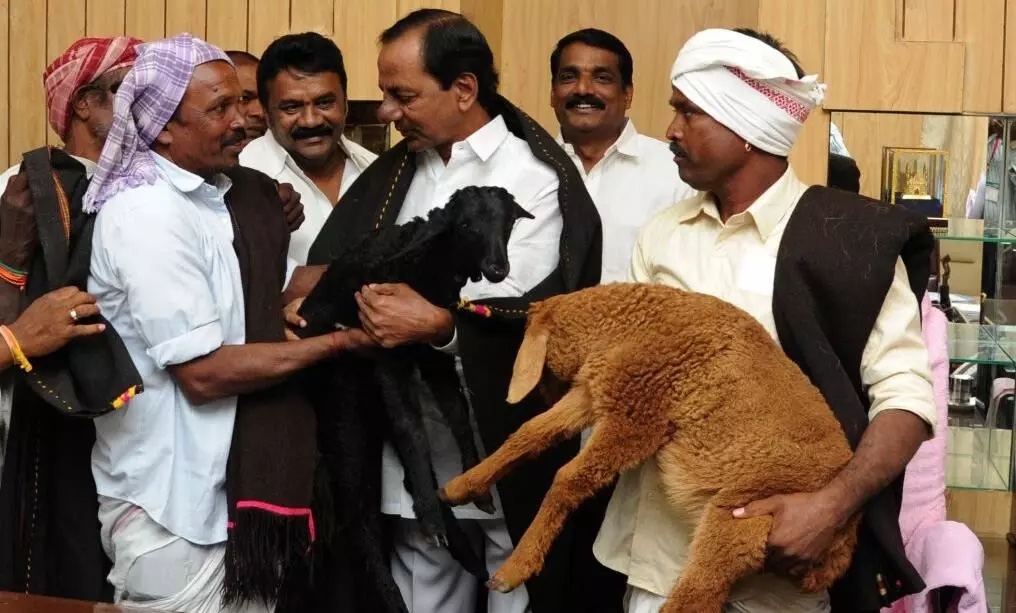
KCR hands over sheep to beneficiaries of the scheme himself: the pastoral economy that the sheep distribution scheme put capital behind for the first time, reaching 3.94 lakh Yadava and Golla Kuruma families.
Sheep Distribution Scheme
The sheep distribution programme was launched by CM KCR on 20 June 2017, in Kondapaka village of Gajwel constituency. Each unit comprised 20 sheep and one ram, valued at Rs.1.25 lakh per unit. The government paid 75 percent, Rs.93,750, and the beneficiary contributed 25 percent, Rs.31,250. By May 2023, 3.94 lakh units, totalling 82.64 lakh sheep, had been distributed to 3,93,552 families. These sheep gave birth to a further 1.32 crore lambs. The accumulated wealth of the Golla and Kuruma communities from this programme exceeded Rs.7,920 crore.
Parameter
Details
Total units distributed
3,94,000 units (20 sheep + 1 ram per unit)
Total sheep distributed
82.64 lakh
Total families benefited
3,93,552
Lambs born from distributed sheep
1.32 crore additional lambs
Total government expenditure
Rs.3,751.15 crore
Beneficiary contribution
Rs.1,250.38 crore
Total programme outlay
Rs.5,001.53 crore
Wealth accumulated by Golla and Kuruma communities
Over Rs.7,920 crore
Primary Sheep Breeders Cooperative Societies in state
8,109 societies with 7,61,895 members
Dairy and Other Livestock Support
Scheme
Details
Milk incentive to dairy farmers
Rs.4 per litre since 2014. 2,95,785 dairy farmers benefited. Rs.361.45 crore spent. Rs.100 crore per year.
Mobile Veterinary Clinics
100 mobile clinics providing free veterinary services. Started 2017. Rs.136 crore spent. 29 lakh cattle treated free of charge.
Fish seedling distribution
Rs.348.93 crore worth of fish fry and Rs.64.73 crore worth of prawn fry stocked in 23,748 ponds and reservoirs, 100% free of cost
Fisheries: From Subsistence to Industry
Fisheries Department
Fish and Prawns: A Doubling of Production in Eight Years
Telangana's fisheries sector was transformed by the combination of Mission Kakatiya, which restored the tank network, and the government's fish seed stocking programme, which for the first time put stock into every water body in the state free of cost. The result was a near doubling of fish production and a fourfold increase in fisheries value between 2016 and 2023.
Year
Fish Production (Tonnes)
Prawn Production (Tonnes)
Total Production (Tonnes)
Total Value (Rs. Crore)
2016-17
1,93,732
5,189
1,98,921
2,252
2017-18
2,62,252
7,783
2,70,035
2,855
2018-19
2,84,211
9,998
2,94,209
3,957
2019-20
2,99,869
10,453
3,10,322
5,012
2020-21
3,37,117
11,734
3,48,851
5,229
2021-22
3,76,142
13,827
3,89,969
5,860
2022-23
4,24,327
14,142
4,38,469
6,656
Year
Water Bodies
Fish Seed Stocked (Crore)
Expenditure (Rs. Crore)
2016-17
3,939
27.85
22.46
2017-18
11,067
51.08
44.60
2018-19
10,776
49.15
42.95
2019-20
15,715
64.08
46.63
2020-21
18,335
68.52
51.80
2021-22
23,263
76.75
77.49
2022-23
23,748
76.70
63.00
Total
414.13 crore fish seed
Rs.348.93 crore
Telangana ranks first in the country with 5,340 Fishermen Cooperative Societies and 3,72,901 members, ahead of Maharashtra with 3,315 societies and Andhra Pradesh with 2,347. The state also launched Asia's largest freshwater aqua hub at Mid Manair Dam in Rajanna Siricilla district in April 2023, with an expected production of 1.20 lakh tonnes per annum, direct employment for 4,800 persons and exports valued at Rs.1,000 crore.
Horticulture: Telangana's Ranking in India
Horticulture Department
12.94 Lakh Acres, 61.64 Lakh Metric Tonnes
Though horticulture occupies only 7 percent of Telangana's total agricultural area, it contributes 34 percent of the state's agricultural gross value output. The government brought 8.80 lakh acres under micro-irrigation since 2014, with 100 percent subsidy for SC and ST farmers, and established Centres of Excellence for Vegetables, Flowers and Fruits that have trained over 30,000 farmers.
Sector
Area (Lakh Acres)
Production (Lakh MTs)
Fruits
4.40
24.79
Vegetables
1.81
16.45
Spices
4.85
9.27
Plantation
0.68
3.67
Flowers
0.10
0.59
Agro Forestry
1.06
6.81
Medicinal and Aromatic crops
0.01
0.06
Total Horticulture
12.94
61.64
Crop
Telangana's National Ranking
Chillies, area
1st in India
Chillies, production
2nd in India
Turmeric, area and production
3rd in India
Mango, production
2nd in India
Oil Palm, oil extraction rate at 19.32%
Highest in the country
Overall horticulture area
9th in India
Overall horticulture production
11th in India
Food Processing: Connecting Farm to Value
Rs.7,000 Crore
Fixed capital base of food processing sector in Telangana, 2023
Over 4,000 food processing units operating across the state, employing approximately 1 lakh personnel. In 2021, the government launched 14 Special Food Processing Zones across 6,017 acres, fully equipped with infrastructure and offering attractive financial incentives including power and water rebates. Mega projects with total investment of Rs.7,200 crore and direct employment of 58,000 persons are at various stages of implementation, focused on animal feed, fisheries, dairy, consumer products, edible oils and beverages.
CM KCR thought to double the income of the farmers by connecting the fish distribution, sheep and cattle distribution programmes undertaken by the Telangana government to the food processing sector. The crops grown locally by the farmers are remunerated, sold on-demand, and the rest of the crop is processed in food centres.
Telangana State Food Processing Policy, 2021
From Field to Table, Key Achievements at a Glance
Value of livestock in Telangana grew from Rs.24,878 crore in 2013-14 to Rs.1,03,895 crore in 2021-22, a 417% increase in eight years.
Sheep distribution reached 3,93,552 Yadava and Golla Kuruma families with 82.64 lakh sheep. These sheep produced 1.32 crore additional lambs, creating wealth of over Rs.7,920 crore for communities that had little before.
Fish production grew from 1.98 lakh tonnes in 2016-17 to 4.38 lakh tonnes in 2022-23. Fisheries value grew from Rs.2,252 crore to Rs.6,656 crore.
414.13 crore fish seed stocked in 23,748 water bodies at 100% government subsidy, making Telangana the first state in India to implement this at scale.
Telangana ranks first in the country in number of Fishermen Cooperative Societies, with 5,340 societies and 3,72,901 members.
Milk production grew from 42.07 lakh tonnes to 58.55 lakh tonnes per annum. Egg production grew from 1,006 crore to 1,767 crore eggs per year.
8.80 lakh acres brought under micro-irrigation since 2014 at Rs.2,236 crore, benefiting 3,20,601 farmers. Yield increase of 52.3%, water saving of 43.8% and power saving of 33% measured under impact assessment.
14 Special Food Processing Zones created across 6,017 acres in 2021, with over 4,000 food processing units and 1 lakh personnel employed in the sector statewide.