Long before the word "statehood" was spoken, the people of this land had already shown what they would do when their water, their forest, their land and their dignity were taken. Komaram Bheem's Jal, Jangal, Zameen. Chakali Ailamma's harvest carried home past the Deshmukh's goons. Doddi Komaraiah falling to the first bullets of the Armed Struggle. Four thousand martyrs between 1946 and 1951. These are the rebellions that made Telangana's political character, and the heroes the united state's textbooks refused to teach.
Every people carries a memory of the moments it refused to submit. Telangana's memory of refusal is longer and deeper than most, and it did not begin in 1969 or in 2001. It begins in the nineteenth century, with Ramji Gond of the Adilabad forests and Turrebaz Khan of Hyderabad rising against the British; it runs through Komaram Bheem's tribal revolt against the Nizam's land seizures; and it reaches its greatest intensity in the Telangana Peasants' Armed Struggle of 1946 to 1951, one of the largest peasant uprisings in the history of the subcontinent. The united state of Andhra Pradesh kept these histories out of its textbooks. This library puts them back where they belong: at the beginning of Telangana's story.
The First Rebels: Ramji Gond and Turrebaz Khan
In the upheavals of 1857 and the years around it, Telangana produced its own rebels against colonial power. Turrebaz Khan led the rising in Hyderabad city, and Ramji Gond raised the Gond country of Adilabad in revolt. Their names were never incorporated into the textbooks of the united state, a neglect that the movement for Telangana would later cite as proof of how thoroughly the region's history had been erased. They stand at the head of a lineage of resistance that every later rebellion would extend.
Komaram Bheem: Jal, Jangal, Zameen
Komaram Bheem was born in 1901 into the Gond tribe of the forests that now form the district bearing his name, Komaram Bheem Asifabad. In 1938 and 1939, the government took over thousands of acres of land around Sirpur for the Sirpur paper industry, while settlers from adjacent regions encroached into Adilabad and occupied Gond lands. Dispossessed in their own forests, the Gonds turned to revolt, and Bheem united the tribes and launched his rebellion from the Babejhari and Jodeghat hills, giving it the slogan that still rings through tribal India: Jal, Jangal, Zameen: water, forest, land.
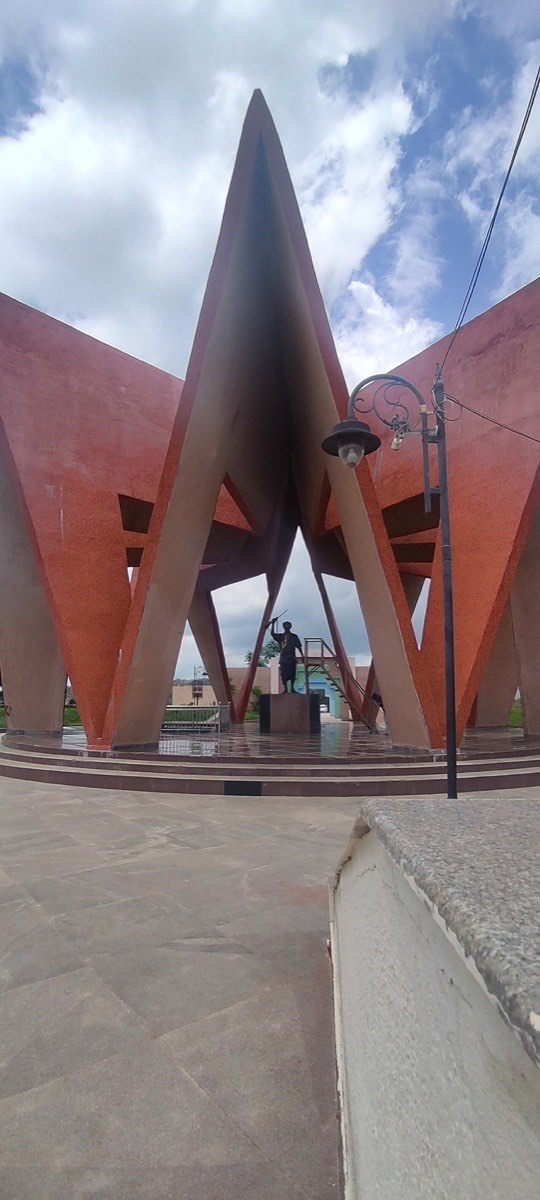
On 27 October 1940, Komaram Bheem was killed in battle against the Nizam's army, betrayed by one of his own supporters. He became, in death, what he had been in life: the symbol of the adivasi's right to the land. Since 27 October 2014, the government of Telangana has officially observed his death anniversary at Jodeghat: the state he never saw honouring the rebellion that helped make it thinkable.
Jal, Jangal, Zameen. Water, forest, land. Three words from the Jodeghat hills that became the inheritance of every struggle that followed.
The slogan of Komaram Bheem's revolt, 1940The Telangana Armed Struggle, 1946 to 1951
The greatest of the rebellions began in the villages. By the 1940s, rural Telangana lived under a feudal order of staggering concentration: the Suryapet Deshmukh held some 1,50,000 acres, the Kalluru zamindar of Khammam 1,00,000, the Visnur Deshmukh of Jangaon 40,000, while the peasants who tilled the land remained tenants forced to work the landlord's fields first. Above the rent sat the extortions: the vetti system of forced, unpaid labour; the nagu vaddi loans of the moneylenders, under which a debt doubled in a single year; the taxes on toddy tappers; the bribes owed to every Patel and Patwari. Against this order, the Andhra Mahasabha and the Communist Party organised the villages under a demand of three words: Bhoomi, Bhukti, Vimukti: land, food, freedom.
Chakali Ailamma: The Woman Who Would Not Yield
In Palakurthi village of Jangaon, under the Visnur Deshmukh, a washerwoman named Chityala Ailamma, Chakali Ailamma, cultivated a small piece of leased land. Because she sided with the Andhra Mahasabha against the Deshmukh, a conspiracy case was foisted on her husband and son, her lease land was seized, and goons were sent to carry away her crop. The Sangam's members fought the goons off and carried the harvest safely to Ailamma's house. The image of that defended harvest made her the heroic woman of the Armed Struggle: the proof that the poorest of the poor could stand against the gadi and win.
Doddi Komaraiah: The First Martyr
On 4 July 1946, in Kadavendi village of Jangaon, villagers marched on the gadi of the Visnur Deshmukh's household after its goons attacked the houses of Sangam members. The goons opened fire on the marchers. Doddi Komaraiah, a young shepherd of the Kuruma community, fell dead, the first martyr of the Telangana Armed Struggle, and the spark that turned an agitation into an uprising. His sacrifice travelled far beyond Telangana: a statue of Doddi Komaraiah was later raised in Moscow.
The Razakars: Terror in the Nizam's Name
As the struggle spread, the private militia of the MIM (the Razakars, led from December 1946 by Kasim Razvi) unleashed terror across the state, looting and murdering in the Nizam's name. On 2 September 1947, when people from thirty villages marched in a peaceful flag procession to Parakala, the Nizam's police and the Razakars opened fire without warning, killing many, in a massacre remembered as Telangana's Jallianwala Bagh. The journalist Shoyabullah Khan, who exposed the Razakars in print, was murdered for it. Villages like Bhairanpally that resisted paid in blood. The memory of the Razakar terror, and of the villages that defended themselves against it, became a permanent part of Telangana's political consciousness.
Operation Polo and What Came After
Between Operation Polo in September 1948 and the merger of November 1956, Telangana lived as part of Hyderabad State within the Indian Union, a brief interval of self-governance whose institutions, from the Secretariat to Osmania University, it would bring intact to the merger. When the merger came, and the long betrayals documented in the chapters that follow began, the people who resisted were the inheritors of Bheem and Ailamma and Komaraiah. The movement of 1969 and the movement of 2001 to 2014 did not emerge from nowhere. They emerged from here.
The Heroes the Textbooks Left Out
- The TRS submission to the Sri Krishna Committee documented that the histories of Telangana's freedom fighters (Turrebaz Khan, Ramji Gond, Komaram Bheem and the martyrs of the Armed Struggle) were never incorporated into the textbook syllabus of the united state.
- Chakali Ailamma and Doddi Komaraiah lived on in the songs and oral traditions of Telangana's villages, carried by the very art forms (Oggu Katha, Dhoom Dham, the ballads of the movement) documented elsewhere in this chapter.
- After statehood, the state government began officially honouring this lineage: Komaram Bheem's anniversary observed at Jodeghat from 27 October 2014, a district named for him, and the Komaram Bheem Adivasi Bhavan raised in Hyderabad.
- Doddi Komaraiah's statue stands in Moscow: the first martyr of a village uprising in Jangaon, remembered on the other side of the world.