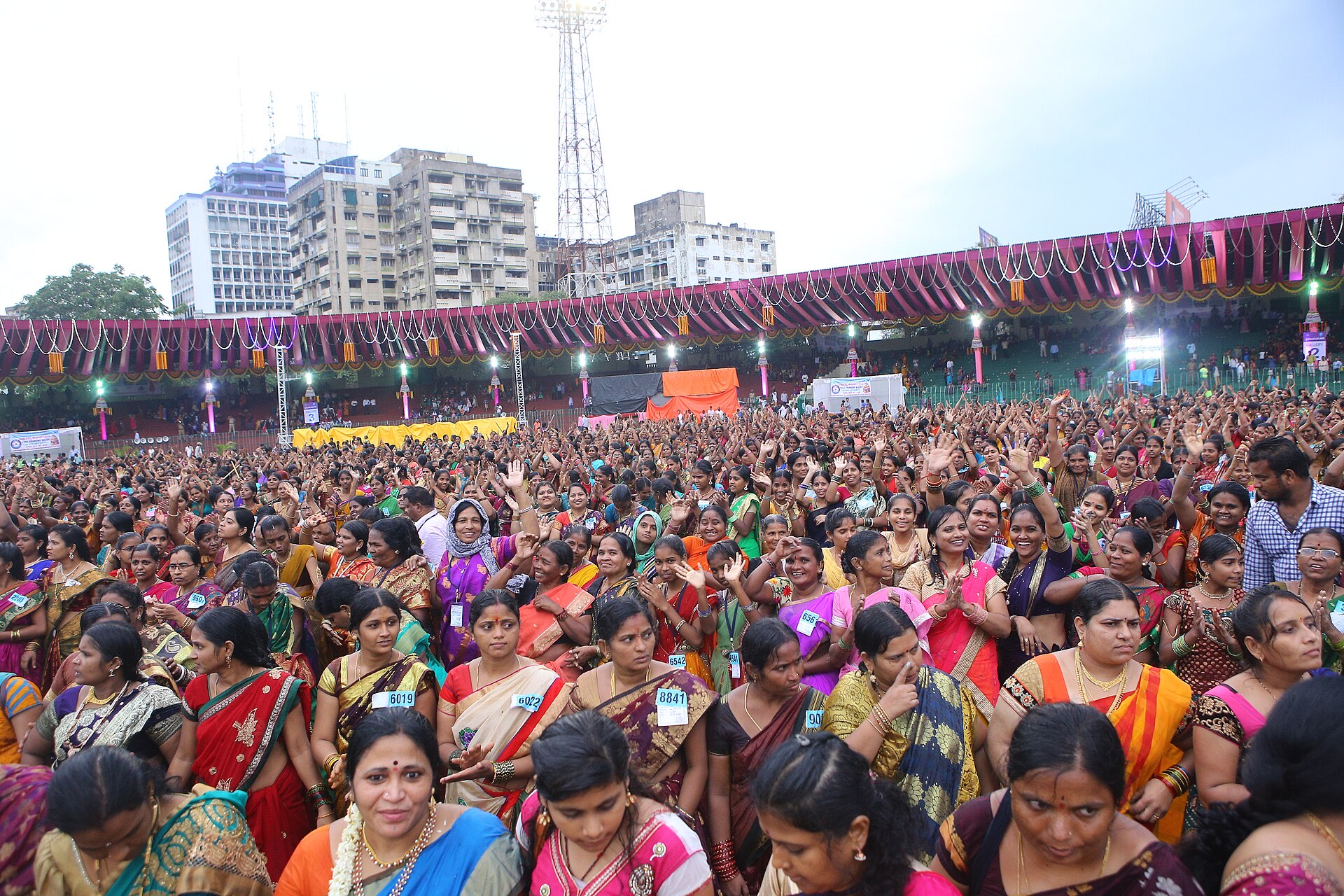
Maha Bathukamma at LB Stadium, Hyderabad: a sea of women, one song, one festival that belongs to Telangana and to no one else. In the new state, Bathukamma became an official state festival.
Photo: Department of Language and Culture, Government of Telangana · CC BY-SA 4.0 · Wikimedia Commons
Telangana's culture is the living expression of everything its history made it. The art forms that the Kakatiyas patronised, the composite traditions that the Qutb Shahis and the Nizams nurtured, the festivals that connect the women of Telangana to the land, the water and each other, and the crafts that have been practised in the same villages for centuries. This is not heritage in a museum. It is a culture that breathes.
Chapter IRecord TL·I·04
Set between India's north and south, Telangana has always been the place where the country's cultures met and produced something new. Its position on the Deccan plateau made it the corridor through which traditions, languages, religions and art forms moved between the subcontinent's great civilisations. The Satavahanas brought Buddhist art and Prakrit poetry. The Kakatiyas brought the martial grandeur of Perini dance and the architectural sophistication of the Ramappa temple. The Qutb Shahis brought Persian poetry, Qawwali and the Ganga-Jamuna tehzeeb. The Nizams brought Urdu literature, Hyderabadi cuisine and the miniature India that the capital city became. All of it layered, over two and a half millennia, into what Telangana's culture is today.
South of North and North of South, Telangana State has long been a meeting place for diverse languages and cultures. It is easily the best example for India's composite culture, pluralism and inclusiveness.
On Telangana's cultural character
Living Traditions
The Festivals of Telangana
Bathukamma
The flower festival unique to Telangana, celebrated during Dasara
Bathukamma is the most distinctly Telangana of all festivals, unique to this land and this people. Women clad in glittering costumes and jewellery carry beautifully stacked Bathukammas, floral arrangements made with Tangedu, Gunugu, Chamanti and other flowers, to the village or street's gathering point. Making circles around the assembled Bathukammas, the women recite songs in a group, songs that carry roots in the Puranas, in history and in the social and political life of their region. The festival culminates in Saddula Bathukamma, when the flower stacks are immersed in nearby tanks and lakes. It has historic, ecological, societal and religious significance, and it belongs entirely to Telangana.
Bonalu
The thanksgiving festival of Goddess Mahakali, celebrated in Ashadam
Bonalu is celebrated during the Telugu month of Ashadam as a thanksgiving to Goddess Mahakali. Women prepare rice cooked with milk and jaggery in a brass or earthen pot adorned with neem leaves, turmeric, vermilion and a lighted diya on top, and carry this offering to the Mother Goddess. A central part of the festival is Rangam, prophecy, where a woman standing atop an earthen pot invokes the goddess and turns oracle. The Ghattam, a copper pot decorated in the form of the Mother Goddess, is taken in procession by a priest accompanied by Pothurajus, bare-bodied men wearing red dhotis who are considered the brothers of the Goddess.
Dasara, Pedda Panduga
The grand festival, the main festival of Telangana
Dasara is the main festival of Telangana, known here as Pedda Panduga, the grand festival. It is celebrated with pomp, gaiety and devotion across all ten districts. The sighting of the Palapitta, the Indian Roller, on Dasara morning is considered auspicious. The Jammi Chettu is worshipped on this day, carrying the legend of the Pandavas who hid their weapons on its branches during exile and returned to victory. Bathukamma is celebrated as part of the Dasara festivities, connecting the flower offering to the broader celebration of the goddess and the season.
Moharram, Peerla Panduga
The festival of unity, celebrated by both Muslim and Hindu communities
Moharram is observed in Telangana with a depth of community participation that reflects the Ganga-Jamuna tehzeeb that the Qutb Shahis and Nizams cultivated over centuries. Known famously as Peerla Panduga, the festival of the Pir or Master, it draws many Hindus as active participants alongside the Muslim community. This shared celebration is one of the most vivid expressions of Telangana's composite culture, a tradition that has been sustained across centuries of coexistence and mutual respect.
Bathukamma, The Soul of Telangana
Of all Telangana's festivals, Bathukamma stands apart as the one that belongs entirely and exclusively to this land. No other state celebrates it. No other culture has it. The songs sung around the Bathukamma carry the voices of Telangana's women across generations, from the Puranas to the most recent struggles of their time. When the women of Telangana sang Bathukamma songs about the statehood movement, they were doing what Telangana's women have always done: making the personal political and the political sacred, through flowers, through water and through song.
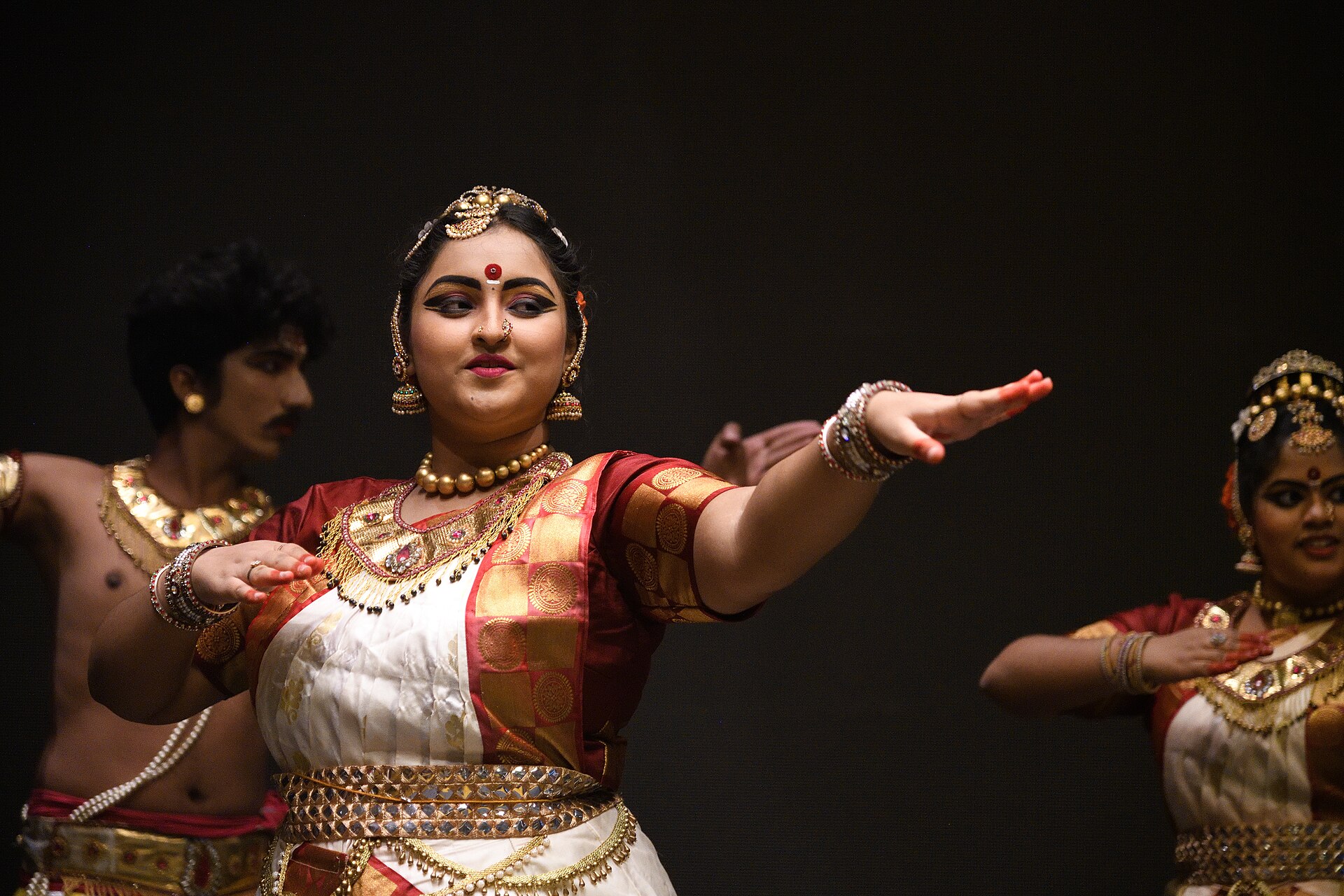
Perini Sivatandavam, the dance of warriors, performed before battle under Kakatiya patronage: vigour, strength and devotion in a form that is uniquely Telangana.
Photo: Biswarup Ganguly · CC BY 3.0 · Wikimedia Commons
Performance and Expression
The Art Forms of Telangana
Perini Sivatandavam
The dance of warriors, evolved under Kakatiya royal patronage, performed by men as a martial offering to Lord Shiva before battle. Combining vigour, strength and devotion, it is one of the most powerful classical forms of South India and is uniquely Telangana in its origin and character.
Chindu Bhagavatham
A theatre art form combining dance, music, dialogue, costume, make-up and stage technique in a uniquely Telangana style. The word Chindu means jump in Telugu, and the performance is characterised by leaps and jumps interspersed throughout. Most stories narrated are drawn from the Bhagavatam. Performed widely across Telangana, it is a form that carries the entire range of the community's storytelling tradition.
Oggu Kathalu
A narrative art form of the communities of Telangana, Oggu Kathalu are stories of the gods and heroes told through song and percussion. The Oggu drum, a double-headed drum carried on the neck, provides the rhythmic foundation for performances that can last through entire nights, carrying epics of divine intervention and human courage.
Golla Suddulu
A traditional storytelling form of the Golla community, Golla Suddulu are performed narratives that combine songs, dialogues and costumes to tell stories of community life, divine grace and social experience. Like many of Telangana's art forms, they were developed by ordinary people facing the challenges of daily life, finding in performance both expression and a form of collective wisdom.
Qawwali and Ghazal
Evolved under the patronage of the Qutb Shahi and Asafjahi rulers in and around Hyderabad, Qawwali and Ghazal became fundamental expressions of the capital city's composite culture. Mushairas, poetry gatherings where Urdu and Persian poets recited their work, were a beloved tradition of Hyderabadi cultural life that drew participants from across religious and social boundaries.
Dhoom Dham
An evolved and composite art form that emerged from the mingling of older traditions, Dhoom Dham is the ubiquitous festival performance of Telangana. It incorporated the old sensibilities of theatre and art while changing content as per the case and place, making it one of the most adaptable and living of Telangana's performance traditions.
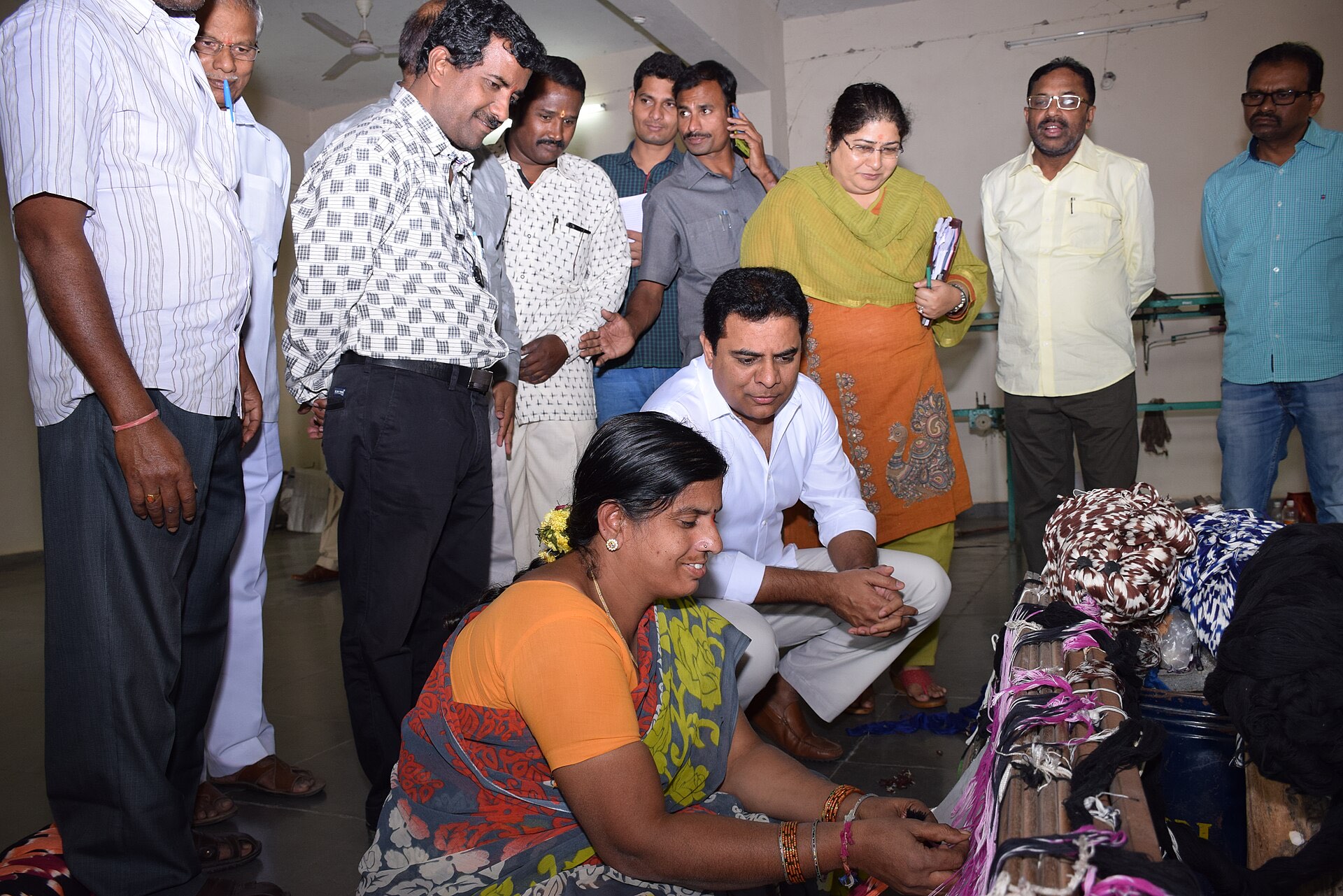
The craft, alive: a weaver ties her warp as Minister K.T. Rama Rao watches. Pochampally ikat, dyed before the loom is ever threaded, is a Geographical Indication of Telangana, and a living livelihood.
Photo: Digital Media, Government of Telangana · CC BY-SA 4.0 · Wikimedia Commons
Made by Hand
The Crafts of Telangana
Bidri Craft
The unique art of silver engraved on metal, with black, gold and silver coatings applied through casting, engraving, inlaying and oxidising. The name derives from Bidar, part of the erstwhile Hyderabad state. Bidri work is a craft that carries the aesthetic of the Deccan court tradition in every piece it produces.
Banjara Needle Crafts
Traditional handmade fabrics crafted by the Banjara communities of Telangana, using embroidery and mirror work in a needlecraft of extraordinary intricacy. Each piece is a record of the Banjara community's aesthetic tradition, their sense of colour and their long history as the travelling communities of Telangana's landscape.
Dokra Metal Crafts
Bell metal craft widely practised in Jainoor Mandal, Ushegaon and Chittalbori in Adilabad district. The tribal craft produces figurines, tribal gods, folk motifs, peacocks, elephants, horses and other objects in a tradition that connects to some of the oldest metal-casting techniques in the world.
Nirmal Arts
The renowned Nirmal oil paintings use natural dyes for depicting themes from the Ramayana and Mahabharata. The origin of Nirmal craft is traced to the Kakatiya era. Its motifs, floral designs and frescoes drawn from the traditions of Ajanta and Ellora and Mughal miniatures, make it one of the most historically layered of Telangana's craft traditions.
Bronze Castings
Telangana is celebrated worldwide for its bronze castings. Using solid casting of icons, the mould is created through several coatings of different clays on a finished wax model, a process that imparts fine curves to the cast image. The tradition connects to the classical bronze-casting arts of the Deccan and continues to produce works of extraordinary refinement.
Pochampally Ikat
The weaving tradition of Pochampally, where the warp and weft threads are dyed before weaving to create geometric patterns of extraordinary precision, is one of the most celebrated textile traditions in India. A Geographical Indication product, Pochampally Ikat is the living legacy of Telangana's weaving communities and their centuries-old mastery of resist-dyeing technique.
Chapter I Complete
The land, the civilisation, the rulers and the culture. Telangana in its full depth, before the story of the merger and the struggle begins. A region with 2,500 years of recorded history, the first woman ruler in the subcontinent, the world's diamond mines, one of Asia's greatest cities and a living culture that breathes through its festivals, art forms and crafts. This is what was merged in 1956. This is what fought to be restored. This is what became the 29th state of India on 2 June 2014.