Education is not merely a matter of schools and colleges. It is the mechanism through which a region's people gain access to employment, social mobility and economic development. To deny a region its proportional share of educational resources is to deny its people their future. In Telangana, this denial was systematic, documented and sustained across five and a half decades of the integrated state.
The merged state of Andhra Pradesh was formed in 1956 with an explicit assurance that regional disparities in education would be removed within five to ten years. By 2001, with forty-five years of the merged state behind it, Telangana's literacy rate was the lowest in Andhra Pradesh and ranked 32nd among all 35 states and union territories in India. The literacy of Telangana's Scheduled Castes and Scheduled Tribes was among the worst in the state. Enrollment at the primary level had never, at any point in the merged state's history, exceeded 32% to 33% of the state total, against an entitlement of 40.69% based on population.
Literacy: Forty-Five Years of Broken Promise
The literacy data from the 2001 Census is unambiguous. Despite the explicit assurance at the time of merger that disparities would be corrected, Telangana's literacy rate remained below both Andhra and the state average after forty-five years in the integrated state.
Literacy Rates by Region, 2001 Census (%)
| Region | Overall | Male | Female |
|---|---|---|---|
| Andhra (Coastal) | 62.90% | 72.00% | 53.50% |
| Telangana | 57.70% | 68.40% | 46.80% |
| Andhra Pradesh | 60.40% | 70.30% | 50.40% |
Source: Census of India, 2001. If the capital city Hyderabad, with its literacy rate of 78.80%, is excluded, the nine remaining Telangana districts rank below even Rayalaseema, said to be the most backward part of Andhra.
Literacy Rates of Scheduled Castes and Scheduled Tribes (%)
| Region | Category | Overall | Male | Female |
|---|---|---|---|---|
| Andhra | SCs | 47.60% | 66.60% | 42.50% |
| Andhra | STs | 38.40% | 47.40% | 29.30% |
| Telangana | SCs | 47.10% | 58.30% | 35.60% |
| Telangana | STs | 33.30% | 44.50% | 21.60% |
Source: Census of India, 2001. The female literacy rate of Telangana's tribal population at 21.60% represents one of the most severe educational deprivations in the state.
Dropout Rates: Children Lost to Poverty
Enrollment figures alone do not tell the full story. Even where children enrolled, Telangana's dropout rates at the primary level were catastrophically higher than the other regions, reflecting the economic poverty that the state government's own development choices had created in the region.
Dropout Rates, Classes I to V, 2007 to 2008 (%)
| Region | Dropout Rate |
|---|---|
| Coastal Andhra | 23.69% |
| Rayalaseema | 13.41% |
| Telangana | 62.90% |
Source: Directorate of Economics and Statistics, AP, 2008. Nearly two thirds of Telangana's primary school children dropped out before completing Class V, primarily due to parental poverty.
The dropout rate of 62.90% in Telangana against 23.69% in Coastal Andhra and 13.41% in Rayalaseema is not a statistic. It is a description of children who started school and could not finish because their families could not afford to keep them there. That poverty was not accidental. It was the direct result of fifty years of diversion of Telangana's revenues to Andhra's development, of neglect of Telangana's irrigation and agriculture, and of systematic underfunding of Telangana's schools, colleges and universities.
Collegiate Education: The Funding Disparity
The salary component paid to teaching and supporting staff constitutes more than 90% of the total expenditure a state government incurs on degree colleges. The number of teachers working in government and government-aided degree colleges is therefore a direct proxy for the amount of money the state is spending on collegiate education in each region.
Number of Teachers in Government and Aided Degree Colleges, 2007 to 2008
| Region | No. of Teachers | Actual % | Entitlement % | Shortfall |
|---|---|---|---|---|
| Andhra | 8,828 | 70.50% | 59.31% | +11.19% |
| Telangana | 3,709 | 29.50% | 40.69% | −11.19% |
| Andhra Pradesh | 12,537 | 100% | 100% | — |
Source: Directorate of Economics and Statistics, AP, 2008.
Grant-in-Aid Released to Private Aided Degree Colleges, 2008 to 2009
| Region | Grant-in-Aid (Rs.) | Actual % | Entitlement % |
|---|---|---|---|
| Andhra | 1,52,14,45,289 | 75.25% | 59.31% |
| Telangana | 49,89,60,900 | 24.75% | 40.69% |
| Andhra Pradesh | 2,02,14,05,189 | 100% | 100% |
Source: Commissionerate of Collegiate Education, Government of Andhra Pradesh. Note: The nine Telangana districts excluding the capital city received only Rs.17,05,51,900, just 8.41% of the total grant, while two Andhra districts alone, Krishna and Guntur, received 30.38%.
University Grants: Half the Money Per Student
The disparity in per capita university grants is perhaps the starkest single data point in Telangana's education story. Between 2004 and 2009, the state government allocated block grants to its six old regional universities. The difference between what Andhra's universities received per student and what Telangana's universities received per student was nearly two to one.
Per Capita Block Grant to the Six Old Universities, 2004 to 2009 (in Rupees)
| Region | University | Per Capita Grant (Rs.) |
|---|---|---|
| Andhra | Andhra University | 35,500 |
| Andhra | Nagarjuna University | 22,700 |
| Andhra | Sri Venkateswara University | 37,500 |
| Andhra | Sri Krishna Devaraya University | 25,000 |
| Andhra Average | 30,175 | |
| Telangana | Osmania University | 17,400 |
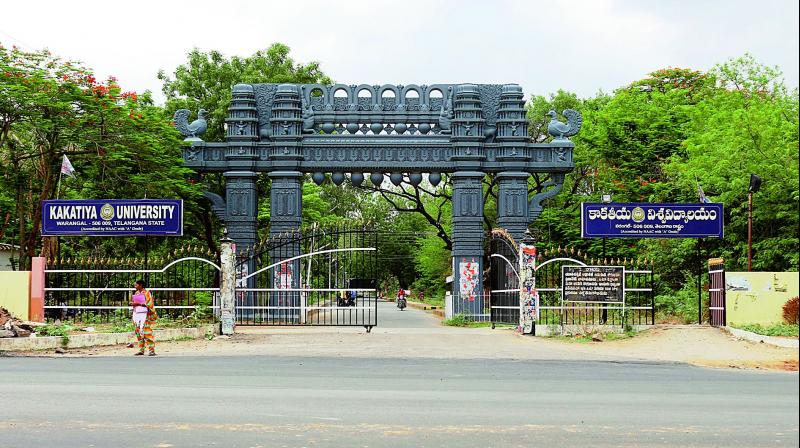
| Telangana | Kakatiya University | 14,000 |
| Telangana Average | 15,700 |
Source: Budget Documents for the Years 2004 to 2009 presented to the AP Assembly. Andhra universities received on average Rs.30,175 per student. Telangana universities received Rs.15,700. This has been going on for five decades.
The contrast becomes even sharper when examining new universities established during the tenure of Chief Minister Rajasekhar Reddy. Three universities, Telangana University in Nizamabad, Mahatma Gandhi University in Nalgonda, and Yogi Vemana University in Kadapa, were started at the same time. The grants released to them from 2006 to 2009 tell their own story.
Block Grants Released to New Universities, 2006 to 2009
| University | Region | Block Grant Released |
|---|---|---|
| Telangana University, Nizamabad | Telangana | Rs.29,50,00,000 |
| Mahatma Gandhi University, Nalgonda | Telangana | Rs.30,51,00,000 |
| Yogi Vemana University, Kadapa | Rayalaseema | Rs.300,00,00,000 |
Source: AP State Council of Higher Education. Two Telangana universities received approximately Rs.30 crores each. One Rayalaseema university received Rs.300 crores. Started at the same time. The same state government.
Professional Education: Seats Denied
The disparity extended to the most critical and expensive sector of higher education: medicine and engineering. In both disciplines, Telangana's share of government college seats was significantly below its population entitlement, while Rayalaseema, with only 17.73% of the state's population, received a disproportionately large share.
Disparities in Professional Education Seats, Government Colleges
| Course | Total Seats | Andhra Seats | Andhra % | Telangana Seats | Telangana % | Telangana Entitlement |
|---|---|---|---|---|---|---|
| Medicine | 1,800 | 1,200 | 66.67% | 600 | 33.33% | 40.69% |
| Engineering | 3,760 | 2,625 | 69.82% | 1,135 | 30.18% | 40.69% |
Source: AP State Council of Higher Education. Of the 600 medicine seats in Telangana colleges, 350 were in the capital city and had ceased to be exclusively available to Telangana students after the merger. This problem does not exist in Andhra or Rayalaseema colleges.
Can anyone assess and compensate the loss caused all these years to the youth of Telangana in the field of education, especially higher and professional education? What would be its impact if this unjust and irrational formula continues to be operational even in the years to come?
On the education disparity in TelanganaThe answer to those questions is that no compensation was offered and the formula did continue to be operational. It continued until 2 June 2014, when Telangana became a separate state and gained the power to make its own decisions about where to build schools, how much to fund its universities and how many professional seats to allocate to its own children. In the first years of the new state, under Chief Minister K. Chandrasekhar Rao's government, new medical colleges, new universities and new welfare schemes were established specifically to address the five-decade deficit that the integrated state had created and refused to correct.