Second class citizenship is not a slogan. It is a condition, and it can be measured. It is measured in revenues taken and expenditure denied, in jobs occupied by outsiders in violation of law, in a language mocked on screen and a history erased from textbooks. This page draws the threads of Chapters III and IV together into the single conclusion they all point to: for fifty-eight years in the integrated state, the people of Telangana were made second class citizens in their own homeland.
Every grievance documented in this library (the diverted surpluses, the abandoned irrigation projects, the violated Mulki Rules, the shuttered industries, the underfunded universities) was, taken alone, an injustice. Taken together, they were something more systematic: a structure. A structure in which one region's people consistently gave more than their share and received less, held the resources and not the power, obeyed the law and watched it suspended whenever it protected them. The name Telangana's people gave to life inside that structure was second class citizenship, and the record bears the name out in every sphere.
The Economic Dimension: Give More, Receive Less
The economic arithmetic of second class status is set out in Chapter III and needs only its conclusion restated here. Telangana, with 40.69% of the state's population, contributed the dominant share of Andhra Pradesh's revenues (74 to 77% when Hyderabad's headquarters receipts are correctly attributed) and received far less than its proportional share of development spending in return. Its tank irrigation collapsed from 13 lakh acres to barely 5 lakh while 82% of the state's canal irrigation benefits flowed to Coastal Andhra. Its inherited industries, from the Azamjahi Mills to the Nizam's Sugar Factory, were closed or sold while new industry rose in Andhra's cities. A region that funded the state lived like the state's poor relation. That is the economic definition of a second class citizen: one who pays first and is served last.
The Political Dimension: Ruled, Not Represented
The political dimension was equally structural. In 54 years of the integrated state, Telangana produced three Chief Ministers who together held office for barely six years. Of the state's 57,899 gazetted officers, only 10 to 12% were from Telangana; in the Secretariat and Heads of Departments in Hyderabad, Telangana's own capital, roughly 90% of staff were from Andhra. When the Supreme Court of India upheld the Mulki Rules in 1972, Parliament was used to annul the judgment within a year. A people whose rights could be voted away by another region's majority, and whose victories in the highest court could be legislated out of existence, did not have representation in any meaningful sense. They had rulers.
In their own homeland, the people of Telangana were made to live as tenants: their revenues collected, their water redirected, their jobs occupied, their language ridiculed and their protests answered with bullets. The demand for statehood was, at its core, a demand to be citizens again.
On the status of Telangana's people in the integrated state of Andhra PradeshThe Cultural Dimension: Identity Under Attack
The economic and political dimensions of second class status are documented in data and records. The cultural dimension is harder to measure but no less real in its impact. The people of Telangana speak a dialect of Telugu that is distinct from the coastal Andhra dialect. Their traditions, festivals, food, music and idiom are recognisably Telangana in their character, shaped by the region's history under the Kakatiyas, the Qutubshahis and the Nizams.
In the integrated state, the media, cinema and public cultural apparatus were dominated by Coastal Andhra. The Telangana dialect was represented in popular culture primarily as the butt of jokes, a marker of backwardness or rural simplicity. The cultural confidence that comes from seeing your own people, your own way of speaking, your own traditions represented with dignity and pride in public life was systematically denied to Telangana's people for fifty years.
This cultural belittlement was not a minor irritant. It was a daily reinforcement of the message that Telangana and its people were lesser than the state's dominant culture. Combined with the economic deprivation and political marginalisation, it created the complete picture of what it meant to be from Telangana in the integrated state: economically behind, politically powerless and culturally diminished.
The Demand That Could Not Be Suppressed
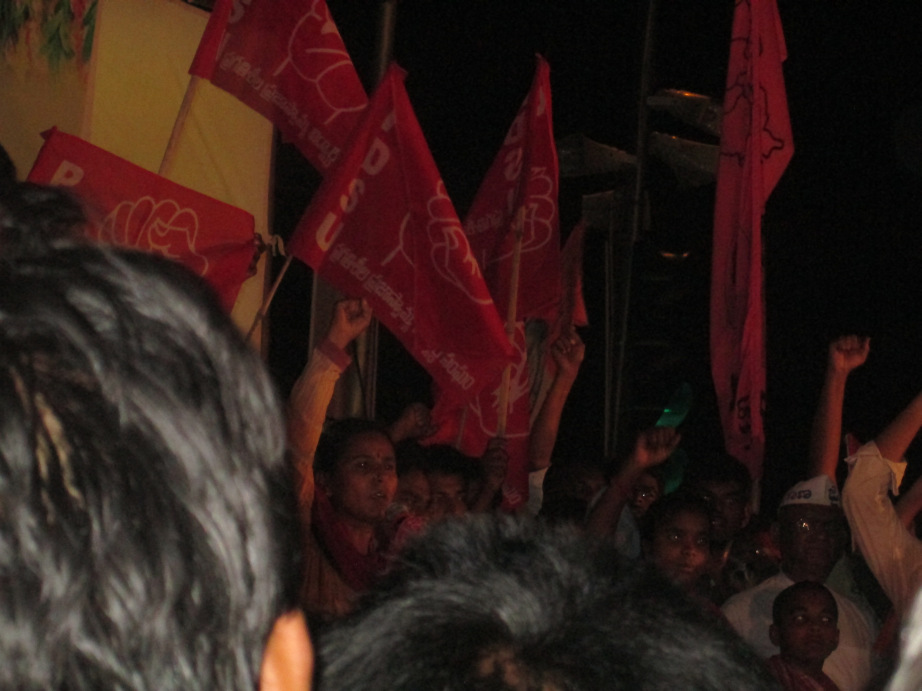
The demand for statehood emerged from the totality of this experience. It was not merely an economic demand, though the economic case was overwhelming. It was not merely a political demand, though the political case was unanswerable. It was a demand to be treated with the dignity that every citizen of a democracy deserves, to have a government that was accountable to you rather than to a majority that did not share your interests, to live in a place where your culture was not mocked and your rights were not stripped away by parliamentary majorities.
The Multiple Dimensions of the Demand for Telangana
- Economic: To stop the diversion of Telangana's revenues to Andhra and to direct the region's resources toward its own development.
- Political: To have a government that was accountable to Telangana's people rather than to Andhra's numerical majority in the legislature.
- Administrative: To have a bureaucracy and administrative machinery that served Telangana's people rather than one dominated by personnel from outside the region.
- Cultural: To have Telangana's dialect, traditions, festivals and identity treated with dignity rather than belittled by the dominant cultural machinery of the coastal region.
- Constitutional: To have rights that were protected by structural reality rather than by agreements, formulas and court judgments that could be stripped away by parliamentary majorities.
- Human: To live as a full citizen in your own homeland rather than as a second class inhabitant of someone else's state.
The demand was voiced before the merger in 1956. It was suppressed by force in 1969. It was answered with broken formulas in the 1970s and 1980s. It was reignited by every new generation that inherited the same structural disadvantage. It was answered with hunger strikes and mass agitation in 2009. And it was finally fulfilled on 2 June 2014, when Telangana became the 29th state of India and its people became, at last, first class citizens of their own state.
Chapter IV Complete
From 1969 to 2014, through police firing and parliamentary betrayals, through broken formulas and suppressed agitations, through farmer suicides and cultural belittlement, the people of Telangana sustained the demand for what was rightfully theirs. The struggle is documented. The sacrifice is recorded. The statehood was earned.
Continue to Chapter V, The Decisive Movement →