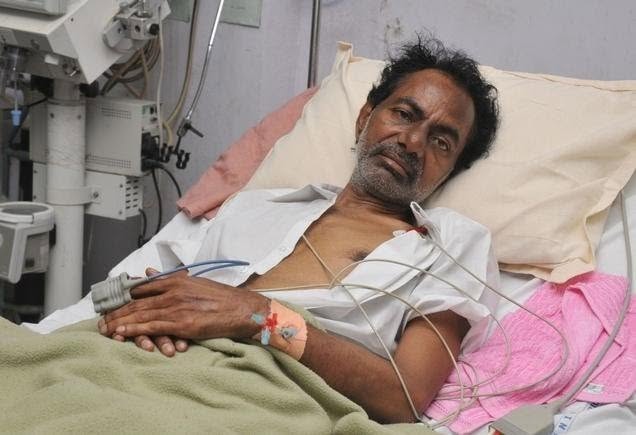
On 29 November 2009, K. Chandrasekhar Rao began a fast unto death for the formation of Telangana state. He was arrested before the fast could begin at its chosen venue and taken to the Khammam sub-jail. He fasted anyway. For eleven days, as his condition worsened and Telangana rose around him, the demand that had been evaded for fifty-three years finally became a question the Government of India could not postpone. On the night of 9 December 2009, the answer came.
The hunger strike of November and December 2009 was the decisive act of the entire Telangana movement, and it came at the movement's lowest political moment. In the general elections held earlier that year, TRS had won only ten Assembly seats and two Lok Sabha seats. Commentators across the state pronounced the Telangana demand finished, its political vehicle broken, its leader spent. The UPA government, freshly returned with a stronger majority, felt no pressure to honour the commitment it had made in 2004 and evaded ever since. Every conventional political instrument had been tried across eight years: alliance, ministry, withdrawal, agitation, elections. All of them had been absorbed and outlasted by Delhi's calculus of delay.
What KCR did next changed the calculus permanently. He announced that he would fast unto death until the Government of India initiated the formation of Telangana state. It was not a gesture and it was not a negotiation. It was a wager of his life against the government's capacity for evasion, made by a fifty-five-year-old man whose movement had just been written off, and it either would end with a state or it would end with him.
Eleven Days That Changed Everything
The eleven days of the fast accomplished what fifty-three years of agreements, formulas, commissions and elections had not: they forced the Government of India to say the word. The announcement of 9 December was won not by arithmetic in a legislature but by a man's willingness to die and a people's demonstration that they stood behind him. When the announcement was walked back on 23 December under Seemandhra pressure, the movement did not collapse into despair. It reorganised, under the TJAC, into the mass phase that would carry it through the Sakala Janula Samme, the Million March and four more years of struggle to the vote in Parliament.
The Double Standard: December 2009
- Congress and TDP leaders from Andhra region who had publicly committed to supporting Telangana statehood at the official All Party Meeting went back on their word within days of the 9 December announcement.
- Some of these leaders, described in the TRS submission as having "vested interests in the real estate business and investments in the corporate sector," openly instigated students and youth of Andhra and Rayalaseema to oppose statehood.
- Large-scale violence and massive destruction of property took place in Andhra and Rayalaseema regions following these instigation. The state government dealt with this leniently.
- During the same period there was total peace and tranquility in the Telangana region, which had celebrated the announcement rather than agitated.
- Cases registered against Telangana activists from 29 November onwards had been promised to be withdrawn by the Home Minister. This commitment by the central government remained unhonoured by the state government.
- The TRS submission noted explicitly: "In dealing with identical situations of unrest in two different regions of the State, the State Government and the law and order machinery behaved differently. It was very lenient and considerate in dealing with situation in the Andhra and Rayalaseema areas, while it has been, and continues to be, ruthless and repressive in dealing with an identical situation in the Telangana region."
The Significance of November to December 2009
The events of November and December 2009 compressed into six weeks the entire history of Telangana's relationship with the Government of India since 1956. A legitimate demand was made through democratic means. The government responded with an announcement. The announcement was walked back under pressure from the dominant regional interest. The double standard in dealing with the two regions' agitations was on full display. And Telangana's people were asked, once again, to wait for a process of consultation that might or might not produce results.
What was different in 2009 was that the political arithmetic had fundamentally changed. The Sri Krishna Committee that was constituted to study the question was itself a sign that the government could no longer simply ignore the demand. The TRS document that was submitted to that committee, the document on which Telangana Library is primarily based, was KCR's comprehensive case for why the formation of Telangana state was not merely desirable but historically necessary, economically documented and constitutionally justified.
The hunger strike of 2009, and the events that followed it, set the stage for the final act. Parliament would vote. Statehood would come. Not in 2009, not in 2010, but in 2014. The five years between Chidambaram's announcement and the actual formation of the state were five more years of waiting for what had already been promised. But the promise of 9 December 2009, even walked back on 23 December, had established something that could not be unestablished: the Government of India had acknowledged, formally and publicly, that the process of forming Telangana state would be initiated. From that day forward, the question was no longer whether. It was when.