No movement in modern India sang the way Telangana sang. When the demand for statehood returned in 2001, it did not travel by pamphlet or press conference: it travelled by song: on the Dhoom-Dham stage, in Gaddar's voice, in the verses of an orphan shepherd who would write the anthem of the state itself. This is the record of the movement's cultural army, and of the long insult it was answering.
The songs did not begin in 2001. They began as an answer to an insult that was already old. In 1934, an Andhra-region writer declared in the Golconda magazine that there were no Telugu poets worth the name in the Nizam's state. The magazine's own editor, Suravaram Pratap Reddy, replied not with an argument but with evidence: the Golconda Kavula Sanchika of 1934, an anthology documenting the poems of 354 Telangana poets. In 1952, the president of the Vishalandhra Mahasabha told students at Hanumakonda's Arts College that they lacked culture and that their spoken language was not Telugu, and the students forced him to stop his speech midway and leave. Among them was a young Jayashankar. The message of both episodes was the same: Telangana's tongue was held in contempt, and Telangana would answer in its own voice.
The TRS submission to the Sri Krishna Committee would later state the grievance formally: Telangana was ridiculed as having no culture of its own, its language mocked as unfit for literature, its festivals belittled. Bathukamma, the region's grandest festival, received no official recognition, no government greetings, no place in the national youth festivals. On Hyderabad's Tank Bund, lined with statues of Telugu greats, not one Telangana figure stood. When the movement returned, this contempt was not a side grievance. It was the wound the songs came from.
Dhoom-Dham: The Movement's Stage
The signature invention of the decisive movement was the Telangana Dhoom-Dham, a travelling cultural show created by Rasamai Balakishan, inspired by Anthadupula Nagaraju's folk programme Janapada Jatara. A Dhoom-Dham brought scores of artists and singers together on one stage, in the forms Telangana's villages had carried for centuries: Oggu Katha, Chirutalu, Kolatam, Bathukamma, Golla Suddulu, Ekanadham. The first show was held at Kamareddy on 30 September 2002, barely a year after TRS was founded; then Sangareddy, then Siddipet, then Hyderabad. When Dhoom-Dham celebrated its tenth anniversary at the Indira Priyadarshini Auditorium on 22 December 2012, inaugurated by Guda Anjaiah and Gaddar, it had done what no press conference could: carried the meaning of statehood into every village that ever hosted a show.
The Voices
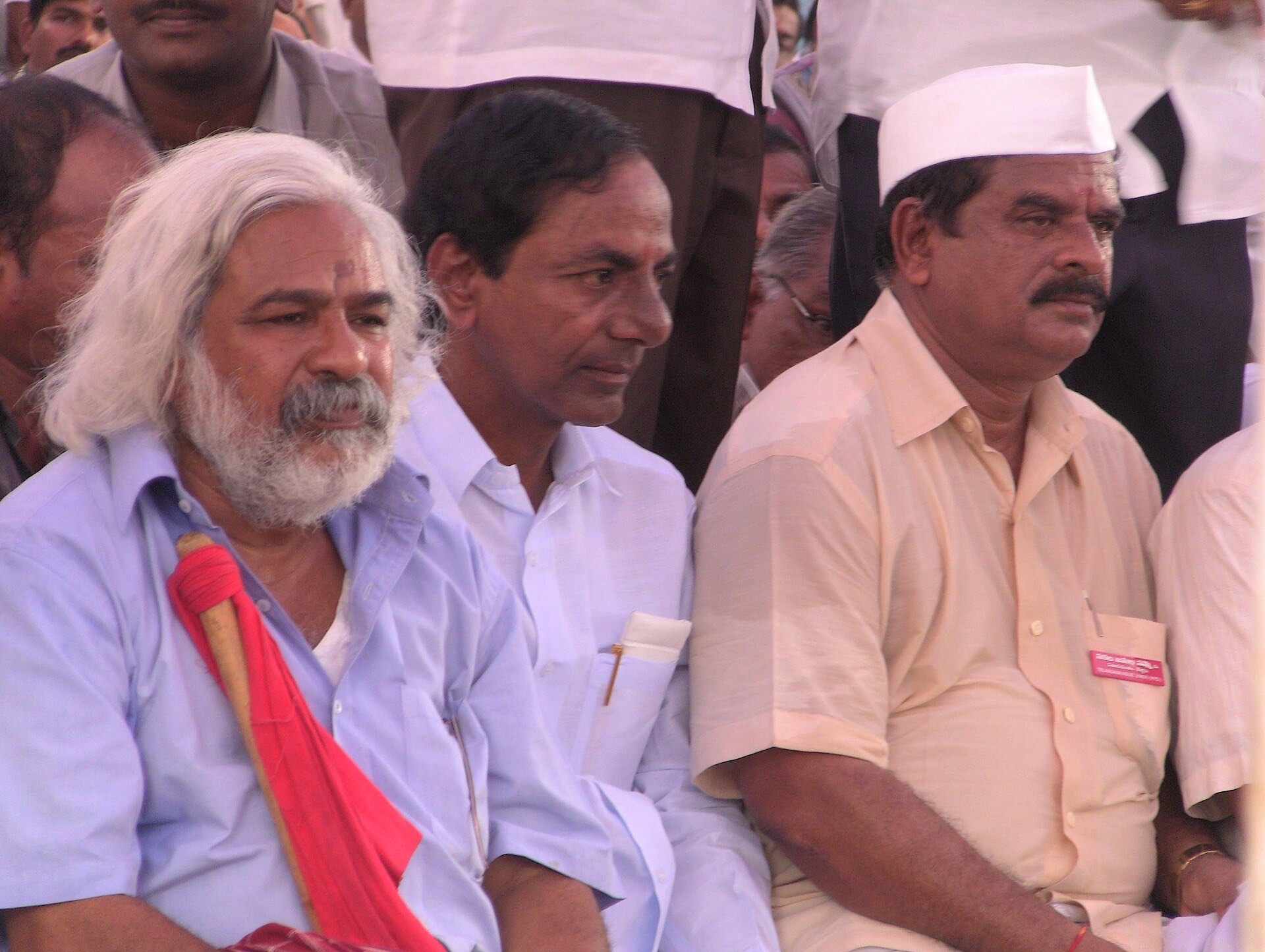
Gaddar was the most famous of them, the revolutionary balladeer whose songs had carried the people's grievances for decades before statehood became a realisable demand, and who shared daises with KCR and the movement's leadership in its decisive years. Around him stood a whole generation of singers who set the agrarian tragedy of the 1990s to melody: Goreti Venkanna's "Palle Kanneru Peduthundo," the village weeping; Kura Devender's "Mitra"; Warangal Srinivas's album Nurendla Na Uru. These were not protest songs written for the movement. They were the movement, in the only medium that reached every home in a region where the tanks had silted, the wells had failed and the farmers were dying.
And there was Ande Sri. Born Ande Yellaiah in Rebarthi village of Warangal district, an orphan who never learned to read, he worked as a shepherd and sang as he worked, a "natural poet," discovered when Swami Shankar Mahraj of Sringeri Matam heard him sing. His songs ("Uru Telangana, Na Peru Telangana," "Chudu Telangana," "Palle Neeku Vandanalamma") travelled the movement's stages, and one of them travelled further still: "Jaya Jaya He Telangana, Janani Jaya Ketanam," the song that became the anthem of the state of Telangana. Kakatiya University, which had once conferred its honorary doctorate on Kaloji, conferred one on the shepherd who could not read. No single life says more about what the movement's culture was.
The Cultural Arsenal of the Movement
- 1934: Suravaram Pratap Reddy's Golconda Kavula Sanchika documents 354 Telangana poets, answering the claim that Telangana had none.
- 1952: students at Hanumakonda's Arts College force the Vishalandhra Mahasabha president to abandon a speech insulting Telangana's language and culture.
- 30 September 2002: the first Telangana Dhoom-Dham at Kamareddy, Rasamai Balakishan's creation, carrying Oggu Katha, Chirutalu, Kolatam, Golla Suddulu and Bathukamma onto the movement's stage.
- The singers of the agrarian crisis: Goreti Venkanna, Kura Devender, Warangal Srinivas: the tragedy of the tanks and the debts, set to melody.
- Ande Sri, the unlettered shepherd-poet of Rebarthi, writes "Jaya Jaya He Telangana", the song that becomes the state's anthem.
- 22 December 2012: Dhoom-Dham's decade celebrations in Hyderabad, inaugurated by Guda Anjaiah and Gaddar.
Telangana people are ridiculed that there is no specific culture of Telangana; that Telangana language is not suitable for any literary purposes.
The TRS submission to the Sri Krishna Committee, recording the cultural contempt the movement rose againstWhy the Songs Mattered
The political history of the movement (the party, the coalition, the fast, the TJAC, the vote) is told in the other pages of this chapter. But the political instruments all depended on something prior: a people who believed their identity was worth a state. That belief was not built in assembly halls. It was built at ten thousand village performances, in the call of a drum and the answer of a crowd, in the moment a farmer heard his own dialect, the one he had been told was not Telugu, sung back to him as something beautiful. The Sri Krishna Committee would describe the Telangana movement as a movement of the masses. It was the singers who made the masses a movement.
When statehood came, the state answered its cultural army in kind: Bathukamma became a state festival celebrated at the grandest scale, the decennial celebrations filled Hyderabad's auditoriums with the movement's art, and Ande Sri's song rose as the official anthem. The contempt of 1934 was answered, at last, in full.