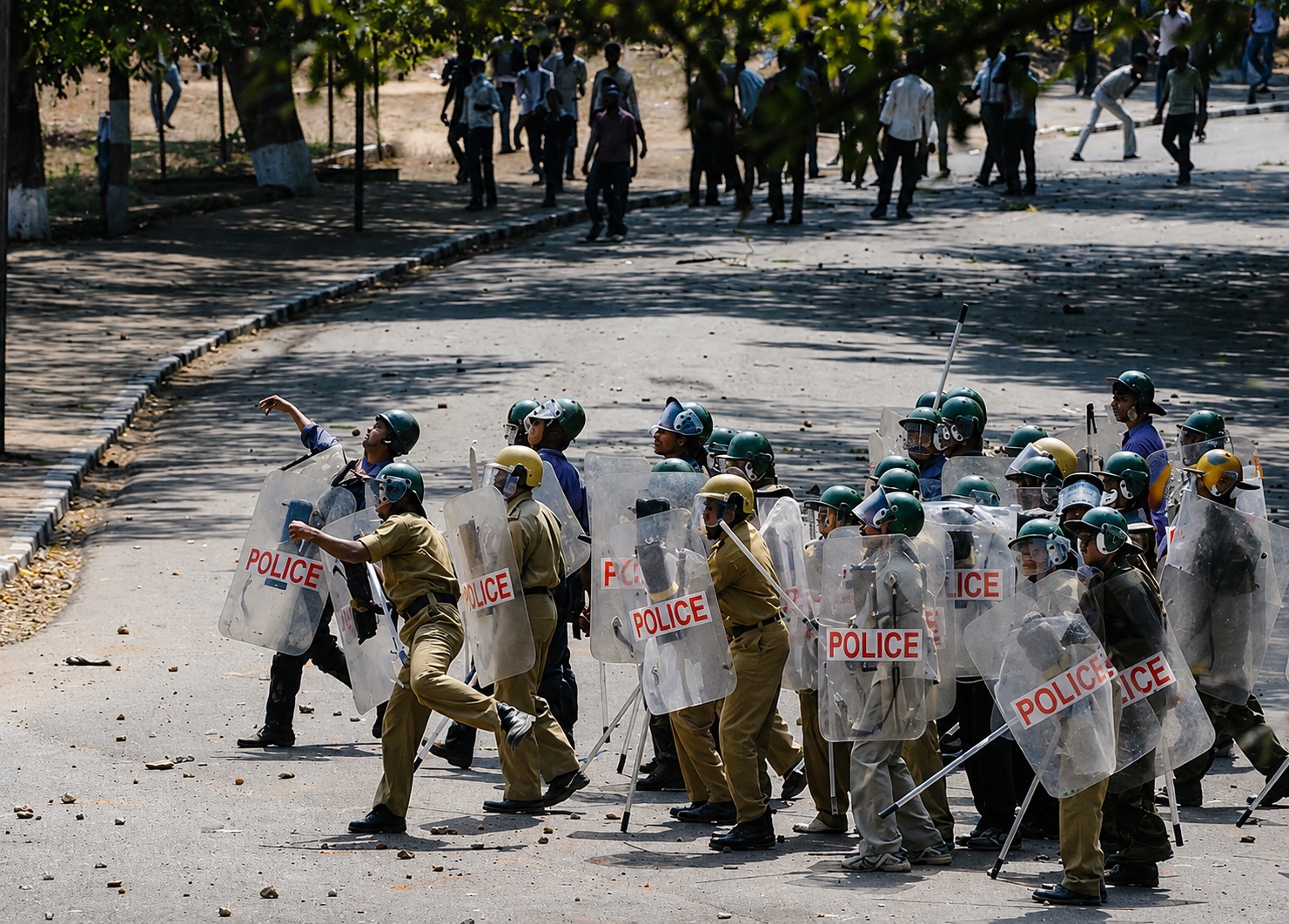
Police face student protesters at Osmania University, 15 February 2010. The university's grounds were the epicentre of student resistance in 1969 and again from 2009 to 2014.
Between 2009 and 2014, Telangana's people took the demand for statehood from the assembly halls and coalition negotiations into every street, every village, every campus and every workplace in the region. The Sakala Janula Samme, the Million March, the Maha Garjana, the Sagara Haram, the Vanta Vaarpu, the relay fasts, the padayatras, the bandhs, each was a different expression of the same settled will. Together they constituted the most sustained and broadest popular movement in the history of the Telugu people.
Chapter VRecord TL·V·05
Political parties negotiate in Delhi. Leaders make speeches from stages. But movements are made in the streets, in the fields, in the coal mines, in the classroom and in the courthouse. The Telangana movement between 2009 and 2014 was a movement of politicians and professors and poets, but it was equally, and perhaps more essentially, a movement of students who stopped going to class, government employees who stopped going to work, lawyers who stopped going to court, coal miners who stopped going underground, auto rickshaw drivers who stopped their engines, farmers who left their fields and ordinary men and women who simply walked, in their millions, to make their presence felt in the capital of the state that had denied them their rights for fifty-three years.
The mass movement phase, orchestrated under the TJAC's coordination with KCR's political direction, produced a series of landmark events that became the defining images of the final years of the struggle. Each event was different in form. All of them were identical in meaning: Telangana's people were not going to stop, could not be stopped, and would not be satisfied with anything less than a separate state.
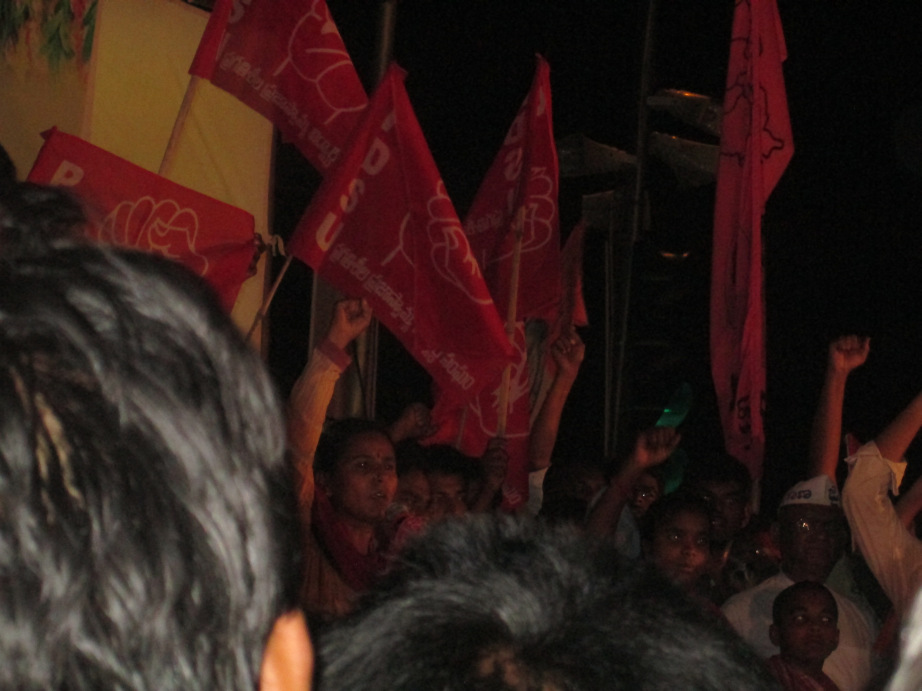
PDSU activists raise pro-Telangana slogans at Gun Park, Hyderabad. Between 2009 and 2014 the movement lived in exactly such gatherings, night after night, across all ten districts.
Photo: Muzammil · CC BY-SA 3.0 · Wikimedia Commons
The Major Events of the People's Movement
16 December 2010, Warangal★ Landmark Event
Telangana Maha Garjana
The Great Roar of Telangana. An estimated 25 lakh people gathered in Warangal for what became the largest single gathering in the history of the Telangana movement. KCR addressed the crowd alongside Prof. Jayashankar, who had spoken for Telangana before audiences of ten in village halls for five decades, and brought the same conviction and passion to 25 lakh people in Warangal's open grounds. The Maha Garjana announced to the nation that this was no longer a political demand of one party. It was the settled will of an entire people.
10 March 2011, Hyderabad★ Landmark Event
Sagara Haram, The Million March
Organised by the TJAC at Tank Bund in Hyderabad, the Million March brought together people from every district of Telangana who converged on the state capital to demand what was theirs. KCR and Kodandaram arrived at Tank Bund in the afternoon, and all participants took a collective pledge to fight for the formation of Telangana. The march demonstrated that the capital city of Hyderabad, which Andhra claimed as a shared heritage, was unmistakably a Telangana city whose people stood unambiguously for a separate state.
13 September to 24 October 2011★ Landmark Event
Sakala Janula Samme, The All-People's Strike
The most comprehensive general strike in the history of the Telangana movement. Sakala Janula Samme, strike by all people, lasted 42 days. Government employees throughout Telangana stayed away from work. Lawyers boycotted courts. 60,000 coal miners of Singareni Collieries joined the strike, stopping the coal that powered Andhra Pradesh's electricity. State road transport employees, electricity board employees, state teachers, all joined. Road blockades on national highways were organised. Rail blockades were organised. The strike paralysed the administration of Telangana for six weeks and demonstrated, more completely than any previous action, that every section of Telangana's society was united behind the demand for statehood.
42
Days of the Sakala Janula Samme, September to October 2011
Government employees, lawyers, coal miners, teachers, transport workers, electricity workers. Every section of Telangana's public life joined. 60,000 Singareni miners stopped the coal. The administration of the region was paralysed for six weeks. No comparable strike had been seen in the history of any statehood movement in independent India.
17 February 2011
Non-Cooperation Movement
The TJAC launched a non-cooperation movement that lasted 16 days, with participation by 3 lakh government employees who refused to attend to government work. It was an early demonstration, before the Sakala Janula Samme, that Telangana's government employees were willing to sacrifice their salaries and risk disciplinary action for the cause of statehood.
12 September 2011, Karimnagar
Janagarjana Sabha
A massive public meeting at Karimnagar, attended by over a million people, addressed by KCR alongside TJAC leaders and leaders from all participating political formations. It was at this meeting that the Telangana Employees Union first called for the Sakala Janula Samme that would begin the following day and last 42 days.
2 October 2011, Rajghat, New Delhi
Silent Vigil at Gandhi's Samadhi
KCR, Kodandaram and the movement's leadership observed a silent vigil near Gandhi's mausoleum at Rajghat on Gandhi Jayanti, invoking the Mahatma's legacy of non-violent resistance and making visible to the national capital that the Telangana movement stood firmly within the tradition of Gandhian democratic protest.
15 February 2012, Osmania University
Vidyarthi Garjana Sabha
The Telangana Students Joint Action Committee organised the Student's Roar assembly in front of the Arts College at Osmania University, the historic ground of student resistance. Thousands of students gathered to demand the announcement of a separate Telangana state by the centre, keeping the student front of the movement active and visible.
14 June 2013, Hyderabad
Chalo Assembly
The TJAC organised a march to the state assembly, where legislators were in session. Police used tear gas to stop participants. 47 MLAs, 14 MLCs and 1 MP were arrested during the programme. The willingness of elected legislators to court arrest for the cause demonstrated the depth of the political commitment behind the demand.
Throughout 2010 to 2013
Vanta Vaarpu, Roti Hungers and Relay Fasts
The TJAC organised Vanta Vaarpu, the cooking on the streets, as a form of mass protest in which Telangana's people gathered publicly to cook and eat together as an assertion of their collective identity and their determination. Relay hunger strikes, in which one group of protesters would fast and then be replaced by another, ran continuously through the years of the movement, keeping the spirit of sacrifice visible.
Osmania University: The Heart of Student Resistance
Throughout the decisive phase of the Telangana movement, Osmania University occupied a central and irreplaceable role. Its students had been at the forefront of the 1969 uprising. They were at the forefront again in 2009, forming their own Joint Action Committee when KCR began his fast, and maintaining a sustained agitation through the university's iconic Arts College grounds that became a symbol of student sacrifice for the cause.
The Osmania University students were not simply agitating in sympathy with a political demand. Many of them were the direct inheritors of the employment deprivation, educational underfunding and cultural marginalisation that Telangana had experienced for fifty years. They were fighting for their own future. The university's Arts College became a ground of assembly, of protest, of student meetings and of the solidarity fasts that kept national media attention on the movement through its final years. Their contribution to the statehood was immeasurable and is permanently part of the movement's history.
What the Street Movement Achieved
The Scale of the People's Movement, 2009 to 2014
Maha Garjana, Warangal, December 2010: 25 lakh people, the largest single gathering in the movement's history.
Million March, Hyderabad, March 2011: People from all ten districts of Telangana converged on the state capital.
Sakala Janula Samme, September to October 2011: 42 continuous days, every section of Telangana's public life, government employees, lawyers, miners, teachers, transport workers.
60,000 Singareni coal miners joining the Sakala Janula Samme, stopping coal supplies to AP's power stations.
3 lakh government employees in the non-cooperation movement of February 2011.
47 MLAs, 14 MLCs and 1 MP courting arrest during Chalo Assembly in June 2013.
Continuous student agitation from Osmania University through 2009 to 2014.
Relay hunger strikes, padayatras, bandhs and road blockades sustained without interruption across all ten Telangana districts for five years.
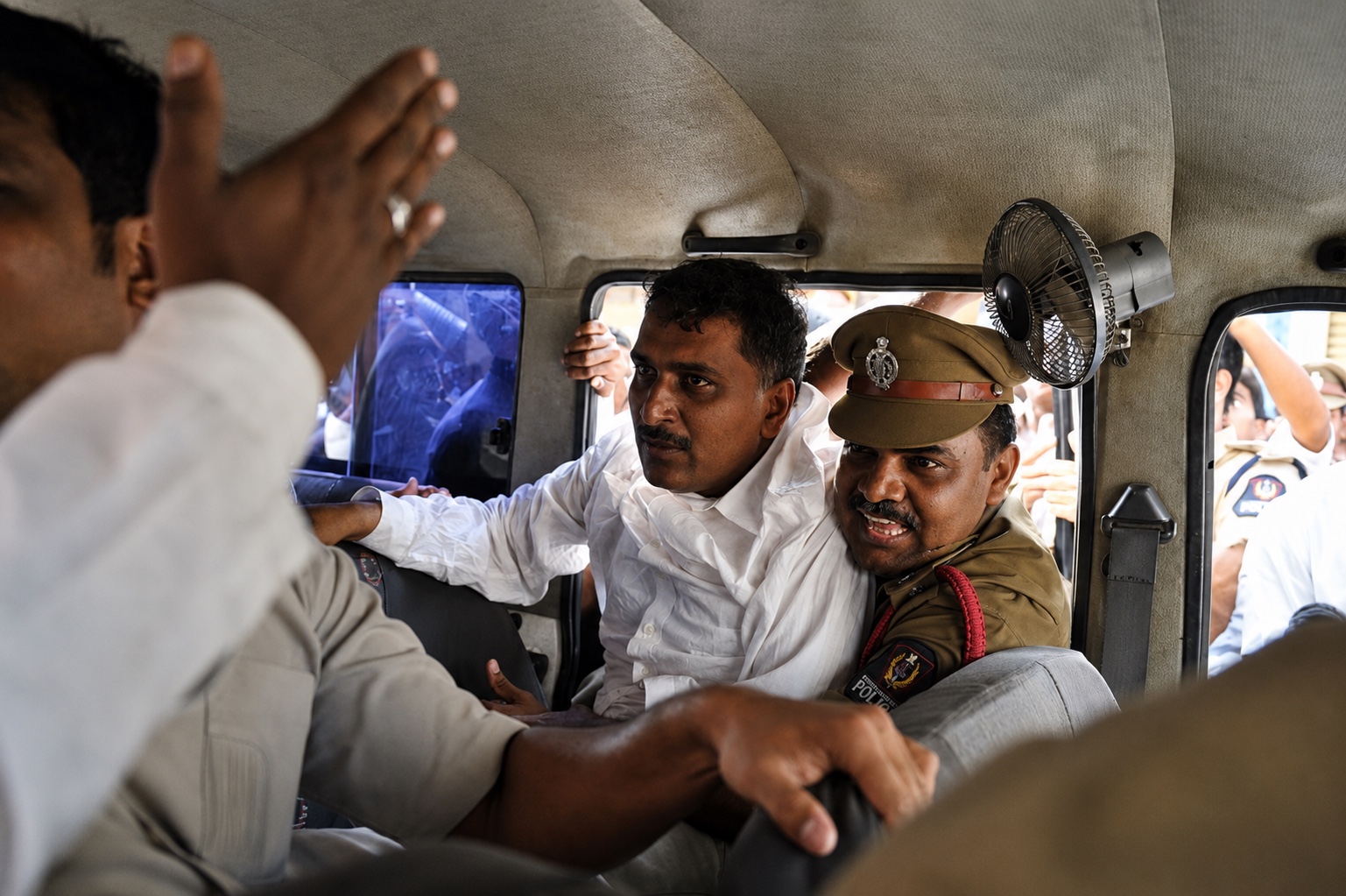
Police detain TRS MLA T. Harish Rao during a protest in Hyderabad, 22 February 2011. Elected leaders courting arrest, again and again, was one of the movement's recurring tactics.
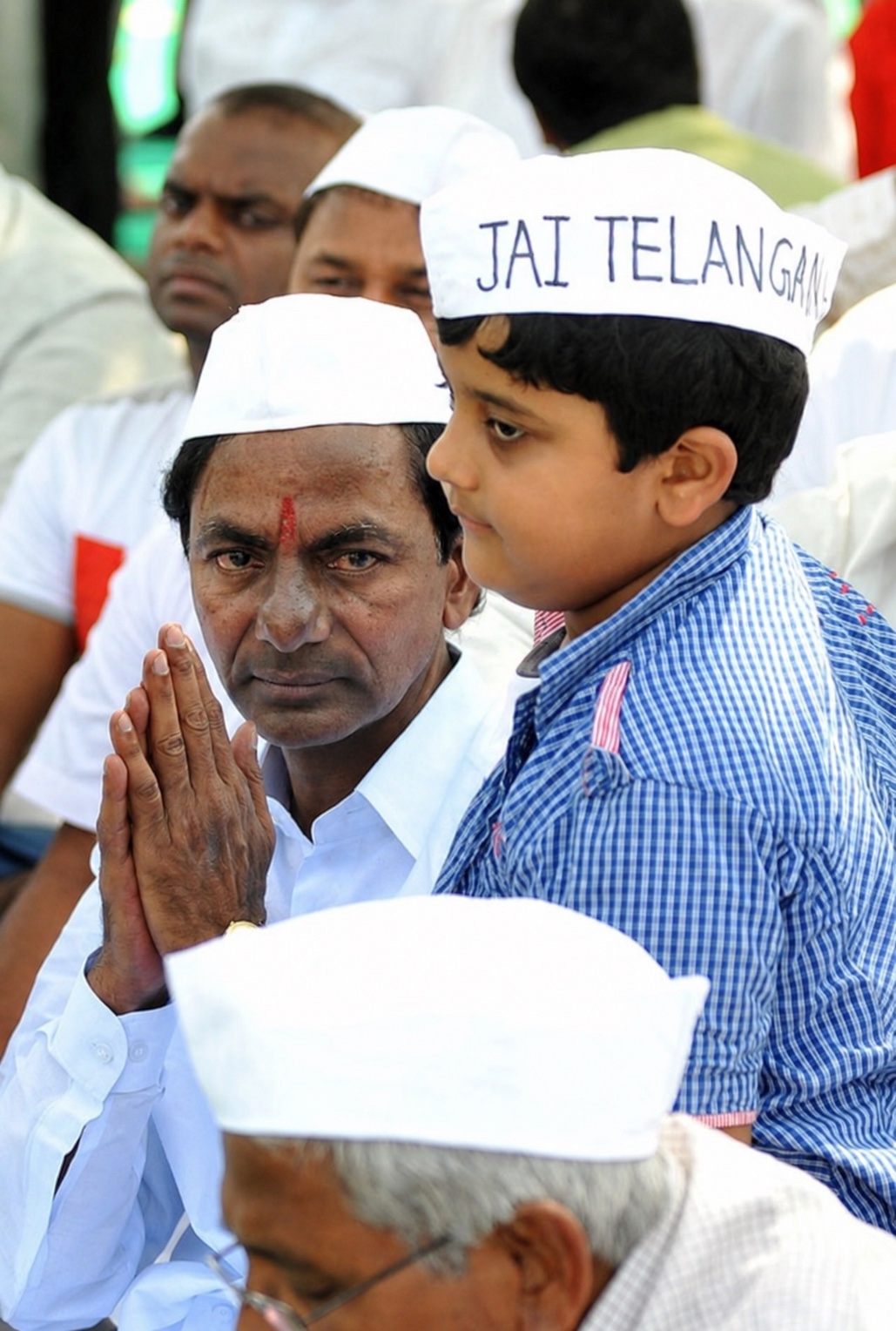
A child in a "Jai Telangana" cap beside KCR at a gathering. The movement was carried by families, not just by politicians and students.
The Srikrishna Committee, in its report, defined the Telangana movement as a movement of the masses. People from every section of society participated in the struggle.
On the character of the Telangana movement, as defined by the Sri Krishna Committee report
That definition, a movement of the masses, is the most accurate description of what the street movement achieved. It transformed Telangana statehood from the demand of a political party into the demonstrated, sustained, organised will of an entire people. When Parliament finally voted in February 2014, it was not simply responding to TRS's electoral leverage or the UPA's political calculations. It was responding to five years of proof, delivered in streets and assembly grounds and coal mines and courthouses across ten districts, that Telangana's people would not stop until they had what they had been promised, and what was rightfully theirs.