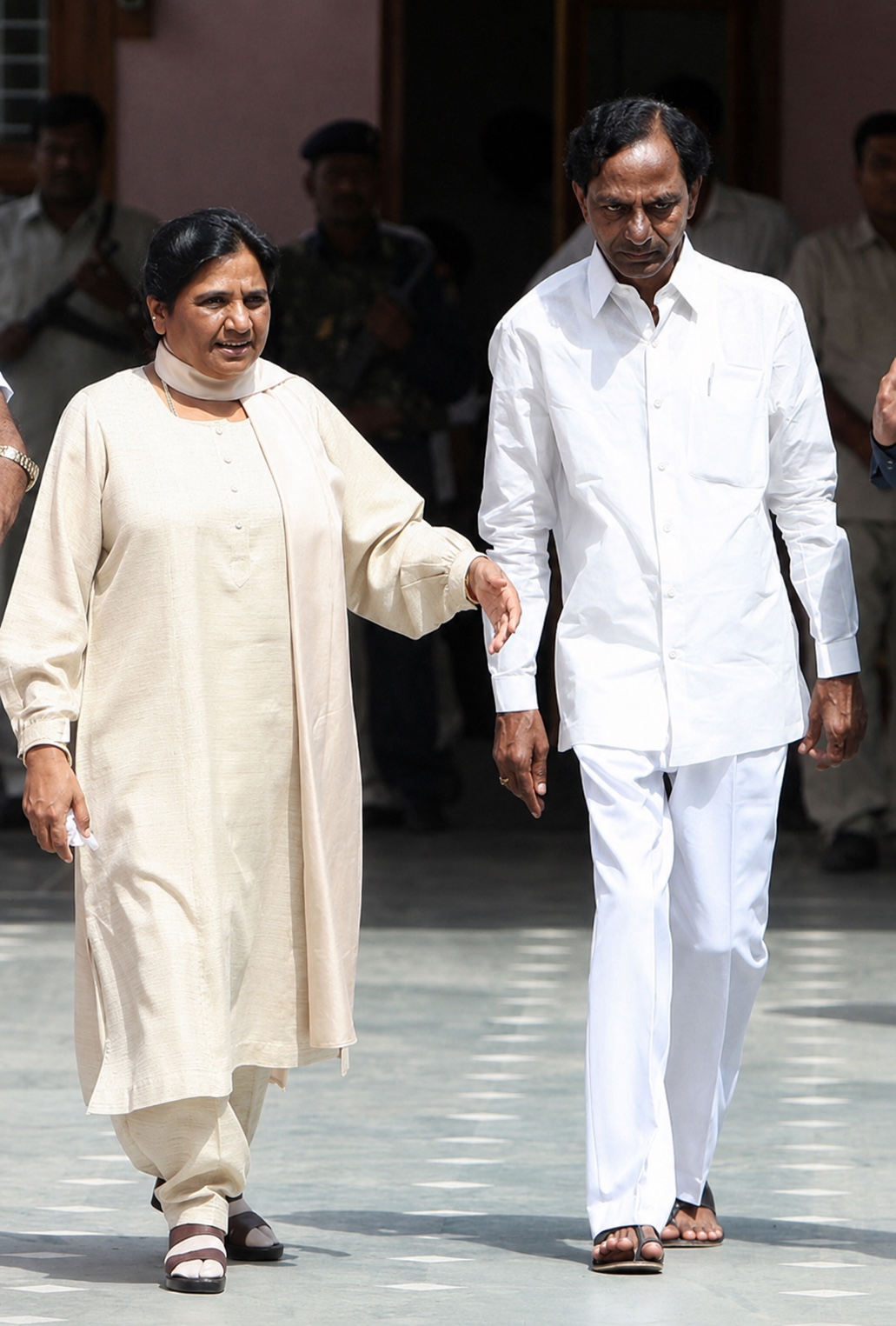
On the evening of 20 February 2014, around forty people huddled around television sets at 23 Tughlaq Road, K. Chandrasekhar Rao's central Delhi residence. At 8.05 pm, the deputy chairman of the Rajya Sabha appeared on the Telugu news channels and announced the passage of the Telangana bill. A cheer went up. People ran into the garden and smeared each other with pink gulaal, the TRS party colour. The thick smoke of fireworks engulfed the premises. The crowd swelled to a hundred. They lifted TRS leaders on their shoulders and chanted: Galli mein bolo, Dilli mein bolo, Jai Telangana. Say it in the street, say it in Delhi. Hail Telangana.
Twenty minutes later, KCR arrived from Parliament in a white Innova carrying his lucky number, 6666, on its licence plate. He flashed two thumbs up. The crowd went wild. His ten-year-old grandson, Kalvakuntla Himanshu, happily throwing gulaal, was asked by a journalist what he thought. "KCR is the Telangana tiger," the boy said. "Everything has happened because of him." KCR read out his acknowledgments: the politicians who had supported the bill, the TRS leaders who had resigned their positions again and again whenever he had asked them to, and above all, the late Prof. Kothapalli Jayashankar, the economist and ideologue who had guided him from the very beginning. That scene of celebration on 20 February 2014 was the culmination of a journey that had begun on a very different day, thirteen years earlier, when one man with no funding and no certainty had founded a party around a single demand.
The Man Who Founded the Party
Kalvakuntla Chandrasekhar Rao was born on 17 February 1954 in Chintamadaka village, Medak district, northern Telangana, the tenth child of Kalavakuntla Raghava Rao. He earned his MA in Telugu literature from Osmania University, a degree that gave him command over the language and poetry of his people in ways that would later make him one of the most powerful orators in Telangana's political history. He was rooted in Telangana from birth, in its soil, its villages, its geography. His fellow students remembered him as passionate about literature and politics, a man with an intimate memory of Telangana's landscape, who could reference a village's pond or its temple or its tank from memory wherever he went.
He began his political life in the Youth Congress in Medak district, joined the Telugu Desam Party in 1983, and first won election as MLA from Siddipet constituency in 1985. He served four consecutive terms as MLA from Siddipet between 1985 and 1999, building a reputation for accessibility and results. He was the kind of politician who remembered every constituent by name. He served as Minister and later as Deputy Speaker of the Andhra Pradesh Legislative Assembly. Through all these years in public life, the condition of Telangana's people, their denied water, their stolen revenues, their displaced employment, was never far from his mind. On 27 April 2001, having concluded that the people of Telangana were being systematically discriminated against and that a separate state was the only solution, he resigned his position as Deputy Speaker and his TDP membership, and founded the Telangana Rashtra Samithi.
The Sacrifice of Founding
Unlike his political opponents, who were backed by the landed Reddy and Kamma entrepreneurs of Seemandhra with their deep financial networks, KCR had no big business backing when he founded TRS. Financing the party was a major challenge. He sold some of his own land on the outskirts of Hyderabad to fund the early campaign. He bought a house in Banjara Hills befitting a party chief and used the remaining money to reach people. His daughter Kavitha described his approach simply: if he has a hundred rupees, he makes it look like a thousand.
Just before the party's launch, KCR called his son KTR and daughter Kavitha, both of whom were in the United States at the time. He told his son: "I think this is my calling and I am going after it." KTR later recalled that he was among the 99 percent of sceptics. KCR's conversation with Kavitha was more emotional. He told her he did not know what the future held, that her marriage was his only remaining responsibility, and asked her to understand if he could not fulfil even that in the way he hoped. He was giving up everything that was certain for something that seemed almost impossible. That is the measure of the man and the sincerity of the commitment.
Simha Garjana: The Lion's Roar
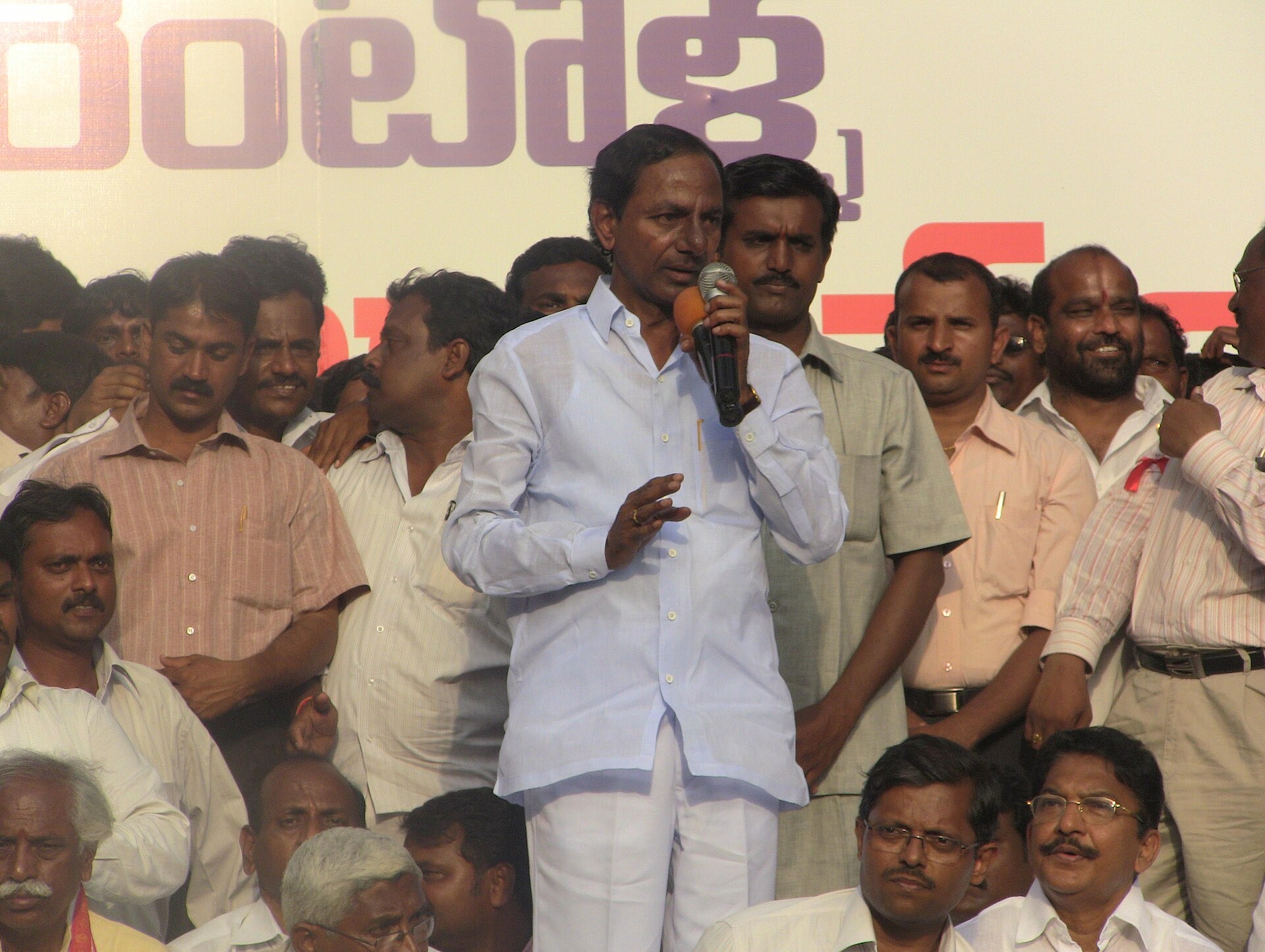
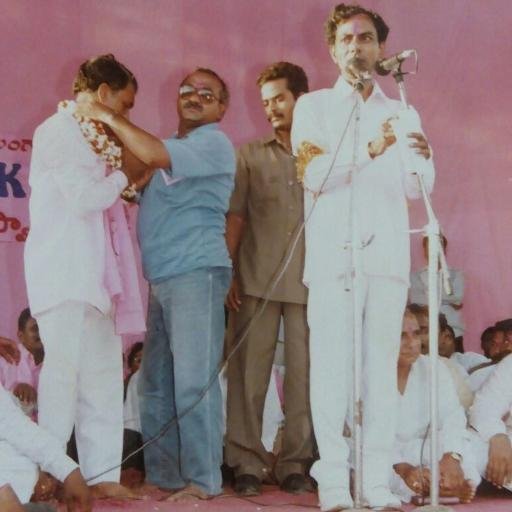
The TRS's first public meeting, titled Simha Garjana, the lion's roar, was held on 17 May 2001 in Karimnagar, where the separatist sentiment had always run deepest. KCR's speech at the meeting became the template for everything that followed. He spoke of the government's failure of Telangana's farmers, its weavers, its adivasis. He drew the contrast that would define his argument for thirteen years: how the TDP had used its central government influence to save a steel plant in Visakhapatnam but had made no such effort for the Fertiliser Corporation plant in Ramagundem in Karimnagar district, while Telangana's people paid the price.
If any one of us strays from the path of achieving a separate Telangana, stone us to death. Politics is the only way to achieve Telangana. We will create a political compulsion for Delhi to form Telangana.
K. Chandrasekhar Rao, Simha Garjana, Karimnagar, 17 May 2001At the same meeting, KCR challenged Chandrababu Naidu to contest against him in the Siddipet by-election, necessitated by his own resignation from the assembly. The challenge was not accepted. KCR won the Siddipet seat, became the first TRS MLA, returned to the state assembly in September 2001 and immediately used it as a platform. When the assembly speaker had previously banned the word "Telangana," encouraging MLAs to replace it with "backward area," those rules had changed. KCR's presence meant they could never be enforced again.
The Helicopter Campaign and the First Victory
For the June 2001 local body elections, the TRS's first electoral test, KCR decided to travel across Telangana in a hired helicopter, covering nearly eighty mandals in a short campaign period. The idea was unconventional, even audacious for a brand new party with no money. But it captured public imagination and allowed KCR to be seen across the entire region in the time available. The result was extraordinary.
The civic poll victories gave the Telangana movement something it had never had before: democratic legitimacy expressed through the ballot box by a party that existed for no other purpose. As senior TRS leader Desapati Srinivas observed: "With the coming of TRS, there was social freedom to talk about Telangana openly. Earlier it was a crime." The victories drew further support from across the political spectrum. Aelay Narendra, a BJP MP and RSS member who had quit his own party to found the Telangana Sadhana Samithi, merged his organisation with TRS within the year. The broad coalition that Jayashankar had always said was necessary was beginning to form.
Neellu, Nidhulu, Niyamakalu
The 2004 Election: Proving the Mandate
The 2004 general elections were the critical test of TRS's electoral strategy. KCR had formed an alliance with the Congress party, extracting a commitment on the Telangana question as the price of his support. He had bargained hard, securing the right to contest six of seventeen Lok Sabha seats and forty-two of 107 Assembly seats for TRS. The results exceeded every expectation.
TRS in the 2004 General Elections
- 5 of 6 Lok Sabha seats won by TRS, equalling the TDP's tally despite the TDP contesting in thirty-three seats.
- 26 Assembly seats won, giving TRS a powerful presence in the state legislature.
- The Congress-TRS-Left alliance handed the TDP its worst ever defeat in Andhra Pradesh.
- KCR entered the Union Cabinet as Labour Minister, giving TRS national executive presence for the first time.
- Aelay Narendra also became a Union Minister, demonstrating the coalition's breadth.
- The UPA Common Minimum Programme included a commitment to consider Telangana statehood at an appropriate time, the first time the demand had been written into the governing programme of the national government.
T News: Giving Telangana Its Own Voice
After the 2009 hunger strike, KCR turned immediately to a project that had been on his mind: giving Telangana its own television channel. Built in a matter of months on what the channel's executive editor described as an impossibly low budget of around Rs.15 crores, T News began broadcasting from the third floor of Telangana Bhavan. KCR was personally involved in every aspect of the launch, from the format to the promos.
The channel's significance went beyond news. For the first time, the Telangana dialect was used on television in a sustained, dignified way. For decades, the Telangana dialect had been used in mainstream media primarily as the subject of comedy or as a marker of rural backwardness. T News used it as the natural language of serious journalism and political commentary. Millions of Telangana's people felt, for the first time, that they had found a voice. The channel broke even in four months, demonstrating both the depth of audience support and the scale of the unmet need it addressed. T News became, in the words of its executive editor, a watchdog against the wrong propaganda of the twenty-odd Andhra channels, counterattacking when necessary and giving Telangana's movement its own media presence in the decisive final years.